OTP Meaning in Text: 3 Easy Meanings Explained
If you’ve ever wondered what does OTP mean in text, you’re in the right place. You get a message that just says “can’t talk, otp” — or maybe your bank just texted you a six-digit code labeled “your OTP.” Or perhaps you’re scrolling through Snapchat and someone’s gushing about their favorite OTP. Same three letters, three completely different conversations. If you’ve ever had to pause and wonder which one applies, you’re not alone.
Understanding what does OTP mean in text comes down almost entirely to context: who sent it, where you saw it, and what the surrounding words say. This guide breaks down the three major OTP meanings in text clearly, gives you real examples for each, and shows you exactly how to tell them apart in seconds.
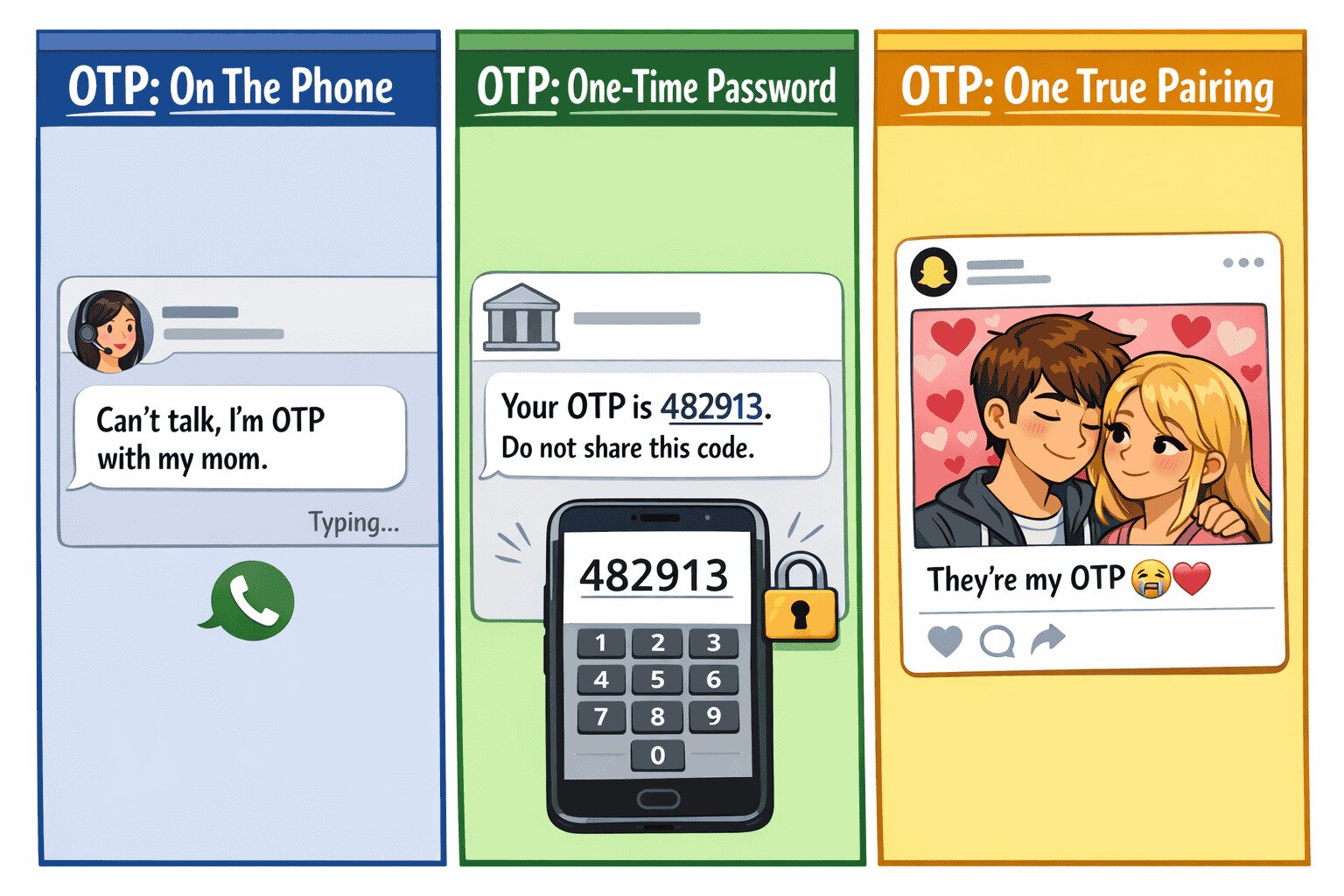
What does OTP mean in text?
The short answer
OTP meaning in text covers three different things depending on context:
- On the phone — used in casual texting to say you’re currently on a call
- One-time password — a temporary security code sent by an app, bank, or website
- One true pairing — a fandom term for your favorite fictional or real couple
In everyday texting between friends, “otp” almost always means “on the phone.” In a message from your bank or a login screen, it means a one-time password. On social media, TikTok, Tumblr, or Snapchat, it’s usually about a beloved couple pairing.
Why OTP has more than one meaning
Text abbreviations evolve across different communities at the same time, which is exactly how OTP ended up with multiple lives. The “on the phone” usage grew naturally out of SMS shorthand — people needed a quick way to explain why they couldn’t respond. The “one-time password” meaning comes from the cybersecurity and banking world, where the acronym has been used in technical documentation for decades. And “one true pairing” originated in online fandom communities in the early 2000s, spreading from forums and fan fiction sites to mainstream social platforms.
None of these communities borrowed from the others. They just happened to land on the same three letters. That’s why what does OTP mean in text can genuinely vary — and why knowing the source of the message is the fastest way to decode it. Like many other internet acronym meanings, understanding OTP requires recognizing the context in which it appears, similar to how NBD meaning in text changes based on whether someone’s downplaying a favor or dismissing a concern, how the DW text abbreviation can mean “don’t worry” in reassuring contexts, or how NR in messages also makes more sense once you look at the surrounding conversation.
The 3 most common answers to what does OTP mean in text
OTP = On the phone
This is the most common OTP meaning in texting between friends, family, or coworkers in the United States. When someone texts you “otp” or “I’m otp,” they’re telling you they’re currently on a phone call and can’t respond properly right now. It’s shorthand for “I’m on the phone” — the same way “omw” means “on my way.”
You’ll typically see this in response to a missed call, a question, or when someone wants to explain a delay in replying. The phrase “im otp meaning” is one of the most searched variations of this term, which tells you a lot of people receive this exact message and aren’t sure what it means.
Common variations you might see:
- “otp, call u back”
- “can’t talk rn, otp”
- “sorry, was otp all morning”
The tone is almost always casual and conversational. If a friend or contact sent it and there’s no security context, this is the meaning to go with. Like other common texting abbreviations such as AFK texting abbreviation, OTP serves as quick shorthand to communicate your current status without typing out a full explanation. Similarly, when someone sends you a message like TFTI meaning in text, they’re using another abbreviation to express a specific sentiment quickly — in that case, “thanks for the invite,” often with a sarcastic tone when they weren’t actually invited to something. The same principle applies to the GTG acronym guide, which helps you understand when someone needs to leave a conversation quickly.
OTP = One-time password
In the world of account security, OTP stands for one-time password — a temporary numeric or alphanumeric code that’s generated for a single use. You’ve almost certainly received one of these even if you didn’t know the term. When you log into your bank and it texts you a six-digit code, that’s an OTP. When an app asks you to verify your identity and sends a code to your email or phone, that’s an OTP too.
The defining features of a one-time password are that it expires quickly, usually within 30 seconds to 10 minutes, and can only be used once. After that, it’s invalid. This makes it far more secure than a static password, because even if someone intercepts it, it’s already useless by the time they try to use it.
One-time passwords are a core part of two-factor authentication (2FA) and account verification flows. When a site says “we’ve sent an OTP to your registered mobile number,” they mean a short-lived verification code — not a permanent password.
Where you’ll see this meaning:
- Bank and credit card SMS alerts
- Login verification from apps like Google, Facebook, or your email provider
- E-commerce checkout confirmations
- Healthcare portals and government websites
OTP = One true pairing
The third major OTP meaning in text lives almost entirely in fan culture and social media spaces. In fandom, an OTP, or “one true pairing,” refers to two characters or sometimes real people that a fan believes are the perfect romantic match. The term implies deep investment: this isn’t just a couple you like, it’s the couple, the one you’d go to bat for in any debate.
The phrase originated in early internet fandom communities around the late 1990s and early 2000s, especially on platforms like LiveJournal and fan fiction archives. Today it’s everywhere — Tumblr, TikTok, Twitter/X, Snapchat, Reddit, and any space where people talk about TV shows, movies, anime, books, or K-pop.
You’ll hear people say things like “they’re literally my OTP” about characters from a show, or post long threads defending their OTP against rival ships, another fandom term for a romantic pairing. If you see OTP on Snapchat or TikTok in a context that involves pop culture or characters, this is almost certainly what it means.
[IMAGE: An example of a social media post using “OTP” in a fandom context, with a caption like “these two are my absolute OTP” and a fictional TV couple reference]
How to tell which OTP meaning someone means
You don’t need to overthink this. A quick look at the source and context of the message will tell you everything.
If it came from a friend or contact
If a real person in your contacts sent “otp” in a text message — especially as a standalone reply or in response to you trying to reach them — it almost certainly means on the phone. This is the dominant casual texting meaning in the US, and it’s used the same way across iPhone and Android.
Ask yourself: Is this person replying to explain why they can’t talk or text right now? Is the message short and informal? If yes, they’re on a call.
If it came from a bank, app, or website
If the message came from a short code, a business name, or an automated system, the OTP is a one-time password. The message will almost always include the code itself and instructions — something like “Your OTP is 847291. Do not share this code with anyone.”
This is the OTP meaning in a text message from a business or app context, and it’s important to treat these codes carefully.
If it showed up on Snapchat, TikTok, X, Tumblr, or fandom spaces
If you’re reading a post, comment, or story on a social media platform — especially one tied to entertainment, pop culture, or fan communities — OTP almost certainly means one true pairing. The surrounding content will usually make this obvious: there will be references to characters, shows, ships, or celebrity relationships.
The OTP meaning on Snapchat specifically tends to follow this fandom pattern, especially among younger users who are active in fan communities.
Does OTP usually mean “on the phone” or “one-time password”?
This is the question most people are actually asking when they search for what does OTP mean in text. You received a message with those three letters and you want a straight answer.
Why the answer depends on who sent the message
There’s no single “most common” OTP meaning in text that applies universally, because the word functions in completely separate contexts that rarely overlap. A text from your friend and a text from your bank are different communication channels with different vocabularies, even though they arrive in the same inbox. The sender is the signal.
If you’re trying to figure out which meaning applies to a specific message you just received, the sender’s identity will resolve it almost every time. A person you know means on the phone. An automated system or business means one-time password. A social media post with pop culture context means one true pairing. These three buckets cover the vast majority of situations you’ll actually encounter.
The most likely meaning in casual text conversations
In a personal text conversation — iMessage, SMS, WhatsApp, or any messaging app where you’re talking to someone you know — OTP almost always means “on the phone.” This is the dominant meaning in casual American texting, and it’s been in consistent use for years. It’s the same category of shorthand as “brb,” “omw,” or “ttyl.”
If a friend, family member, coworker, or acquaintance sends you “otp” with no other context, you can safely read it as “I’m on the phone.” They’re not sending you a security code, and they’re probably not discussing fan fiction. They’re just busy on a call.
The most likely meaning in login and verification texts
When the message comes from a business, app, or automated system, OTP means one-time password, full stop. These messages are structurally different from personal texts — they come from short codes or business names, they include a numeric code, and they explicitly tell you what to do with it. There’s no ambiguity in a message that says “Your verification code is 492817.”
The reason this OTP meaning matters more in that context isn’t just semantic — it’s practical. These codes are tied to your account security. Recognizing them correctly means you know to use them promptly, keep them private, and treat any unexpected OTP as a potential red flag.
What does OTP mean in text: examples by context
Real examples make the difference between understanding a definition and actually recognizing it in the wild. Here’s what does OTP mean in text across each of its three main uses.
Examples of OTP meaning “on the phone”
- “Hey, you free?” → “otp, give me 10”
- “Why didn’t you pick up?” → “sorry was otp with my mom”
- “Can you talk?” → “not rn, otp — call u in a bit”
In each of these, the person is simply explaining they’re currently occupied on a voice call. It’s polite, quick, and completely casual.
Examples of OTP meaning “one-time password”
- “Your OTP for login is 583920. This code expires in 5 minutes.”
- “Use OTP 712048 to verify your account. Never share this code.”
- “Enter the OTP sent to your registered phone number to complete your transaction.”
These messages come from automated systems. The code is the whole point. The OTP code meaning here is always security-related — it’s a verification code text designed to confirm your identity.
Examples of OTP meaning “one true pairing”
- “I just started watching that show and I already have an OTP lol”
- “No one will ever convince me they’re not the best OTP in the whole series”
- “My OTP finally got together in the season finale and I cried”
Notice how these are always about relationships — usually fictional ones. The emotional investment is part of the fandom OTP meaning. It’s not just a couple you like; it’s the couple.
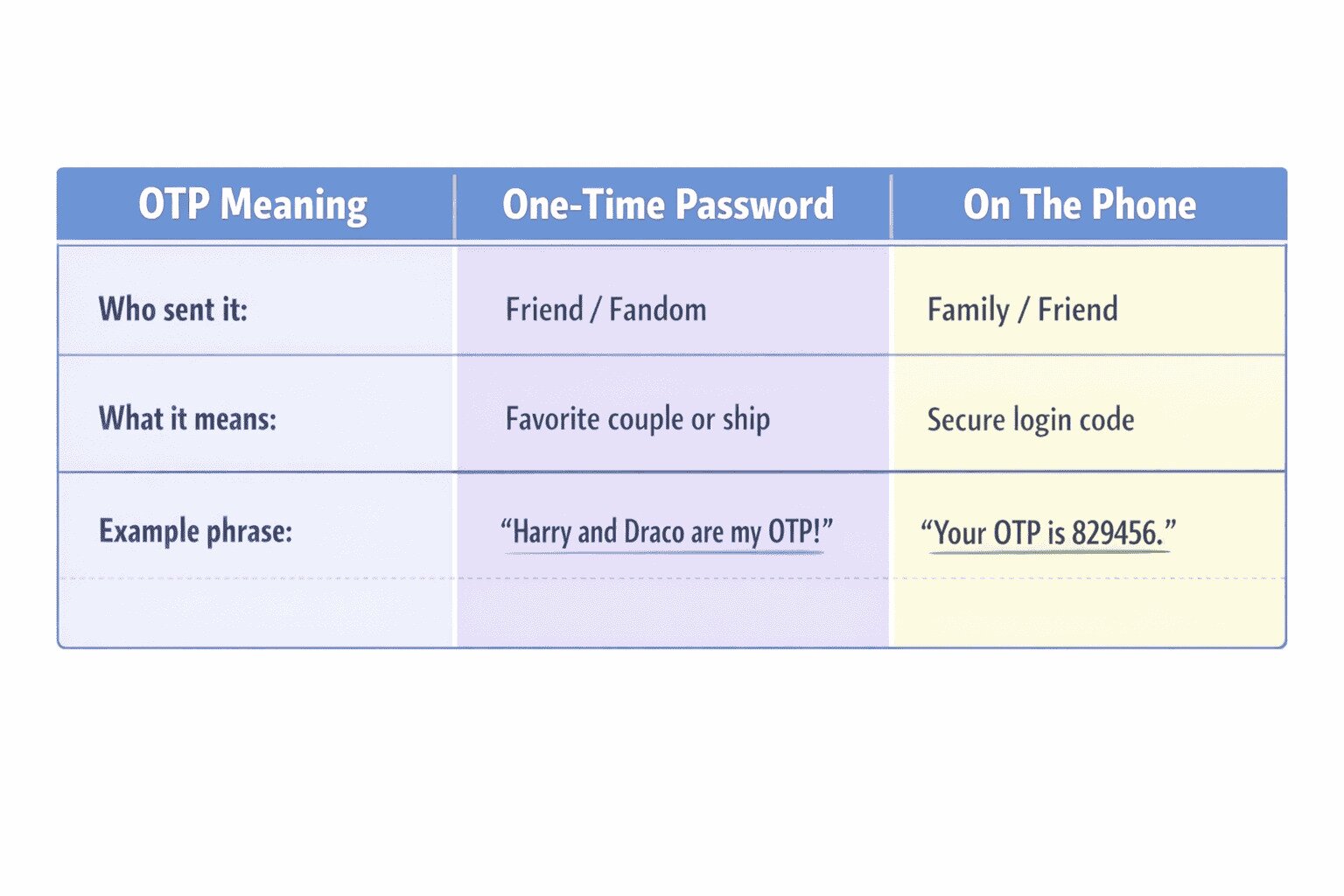
What does OTP mean in a text message from a business or app?
When a business or app sends you an OTP, it’s operating in a very specific security context that’s worth understanding clearly, because mishandling these codes can put your account at risk.
How one-time passwords work
A one-time password is generated by an algorithm that creates a unique, time-sensitive code tied to your account or session. Not all OTPs work the same way under the hood — the type depends on where the code originates:
- SMS/email OTP: sent directly by a bank, retailer, or app for one-time verification — these are server-generated codes, not produced by an app on your device
- TOTP (Time-based One-Time Password): a time-based code generated by an authenticator app like Google Authenticator, Authy, or Microsoft Authenticator
- HOTP (HMAC-based One-Time Password): a counter-based one-time code, less common for everyday consumer logins
What matters in practice is that any OTP — regardless of type — is temporary, single-use, and unique.
- Temporary: It expires after a short window, typically 30 seconds to 10 minutes
- Single-use: Once entered, it can’t be used again
- Unique: Each code is different from the last
This combination makes OTPs dramatically more secure than a password alone. Even if a bad actor somehow obtained your password, they’d still need the OTP to get in — and by the time they try, it’s already expired.
How OTP connects to 2FA and account verification
You’ll most often encounter one-time passwords as part of two-factor authentication (2FA) — a security layer that requires you to prove your identity in two ways. Typically that’s something you know, like your password, plus something you have, like your phone, which receives the OTP.
When an app says “we’ve sent a verification code to your phone,” that’s an OTP. When your bank asks you to enter a code before approving a transfer, that’s an OTP. The 2FA text code you receive is the same thing as an OTP — just described in plain language.
OTP vs. verification code vs. 2FA vs. password: what’s the difference?
OTP and verification code are often used interchangeably in consumer-facing messages. If your bank texts you a six-digit code, it might call it an “OTP” or a “verification code” — both refer to the same thing: a temporary, single-use number sent to confirm your identity.
2FA is the broader security process; OTP is one method used inside it. Two-factor authentication simply means proving your identity in two ways. An OTP delivered by text or app is one of the most common second factors, but it’s not the only one — a fingerprint scan or a physical security key can also serve as the second factor.
A password or PIN is typically something you created yourself and reuse across multiple logins. An OTP is the opposite: temporary, system-generated, and valid for a single use only. You never choose an OTP — it’s always sent or generated for you.
A concrete example: your bank password gets you to the login screen; the 6-digit text you receive afterward is the OTP or verification code used as the second factor. Both are required, but they serve completely different roles.
Important safety tip: never share your OTP code
This cannot be overstated: a legitimate company will never ask you to read your OTP out loud or share it over text, phone, or email. If someone calls you claiming to be from your bank and asks for the code that “just got sent to your phone,” that is a scam — specifically a type of social engineering attack.
Your OTP is the last line of defense between an attacker and your account. The moment you share it, that protection disappears.
What to do if you get an OTP you didn’t request
- Do not share or enter the code anywhere. An unsolicited OTP you didn’t trigger yourself should never be used.
- Ignore any caller claiming to need it. No legitimate bank, app, or service will call and ask you to read the code aloud.
- Sign in only through the official app or website — not through any link sent in the suspicious message.
- Change your password for the account the OTP is associated with, since someone may already have your login credentials.
- Review recent login and device activity inside your account settings to check for anything unfamiliar.
- Sign out of other sessions if the service allows it, to kick out any active unauthorized sessions.
- Contact the bank or service directly if the OTP relates to money movement or account recovery — use the number on the back of your card or the official website, not any contact details from the suspicious message.
It’s also worth knowing that while SMS OTPs are helpful, they are still vulnerable to phishing and SIM-swap attacks. When a service offers an authenticator app or passkeys as an alternative, those options provide meaningfully stronger protection.
What does OTP mean on social media and Snapchat?
The OTP meaning on social media is almost always rooted in fandom culture, and it has a rich history that explains why it resonates so strongly with certain communities.
How fandom communities use “one true pairing”
In fandom, “shipping” refers to wanting two characters to be in a romantic relationship — the term comes from “relationship.” Your OTP is your most-shipped pairing, the one you feel most passionately about. Fans write fan fiction about their OTPs, create fan art, make TikTok edits, and spend considerable energy debating why their OTP is superior to rival ships.
The one true pairing meaning carries a sense of personal identity within fandom spaces. Saying “they’re my OTP” is a declaration of loyalty. It signals not just preference but deep emotional investment in a fictional or sometimes real relationship.
How slang usage differs from standard texting
One thing worth noting is that the OTP slang meaning in fandom spaces has started to bleed into more general social media use. Some people now use “OTP” loosely to describe any couple they find adorable — not just fictional ones. You might see someone post about a celebrity couple being their “real-life OTP,” which stretches the original fandom definition but follows the same emotional logic.
In standard texting between friends who aren’t in fandom communities, this meaning is less common. If your friend texts you “otp” out of nowhere with no pop culture context, they’re almost certainly on the phone — not declaring their favorite ship.
Less common OTP meanings in text
The three meanings covered above handle nearly every situation you’ll encounter. But language is messy, and OTP has picked up a couple of additional uses in more specific contexts.
One trick pony
In some online conversations — particularly in gaming communities and certain professional discussions — OTP is used as shorthand for “one trick pony.” In gaming, especially in titles like League of Legends, a player who exclusively plays one character or role is called an OTP. The phrase carries a slightly dismissive connotation in casual use, implying limited range, but in competitive gaming circles it can also mean someone who has mastered a single character to an elite level.
Outside of gaming, “one trick pony” as an OTP meaning occasionally appears in business or creative discussions to describe someone or something with only one notable skill or feature. If you see OTP in a gaming chat, forum, or Discord server and the context doesn’t fit any of the three main meanings, this is likely what’s being referenced.
When these meanings matter and when they do not
For most people in most situations, the “one trick pony” meaning is a footnote. You won’t encounter it in a text from your mom, a login screen, or a Tumblr post about your favorite show. It lives in a specific niche, and the surrounding context — usually gaming-specific language — will make it obvious.
The practical takeaway is this: if you’ve already ruled out “on the phone,” “one-time password,” and “one true pairing” based on context, and you’re looking at a gaming or competitive context, consider “one trick pony.” In any other situation, one of the first three OTP meanings is almost certainly correct. Don’t overcomplicate it.
[IMAGE: A simple flowchart graphic showing how to identify which OTP meaning applies — starting with “Who sent it?” and branching into friend/contact, business/app, and social media/fandom paths]
Common questions about what does OTP mean in text
Is OTP good or bad in texting?
OTP is neutral in all three of its main meanings. “On the phone” is simply a status update. A one-time password is a security feature. And “one true pairing” is an expression of affection for a fictional couple. None of the common OTP meanings carry a negative connotation on their own.
The only situation where OTP could be considered bad is if you receive a one-time password you didn’t request — that’s a warning sign that someone may be trying to access your account, and you should take it seriously.
What does “I’m otp” mean?
“I’m otp” means “I’m on the phone.” It’s a casual way of saying you’re currently in the middle of a voice call and can’t respond to texts or take another call right now. You’ll typically see it as a quick reply to a missed call or an incoming message, letting the other person know you’ll get back to them shortly.
What does OTP mean in text on Android or iPhone?
What does OTP mean in text is the same question regardless of whether someone is using an Android or iPhone. The meaning doesn’t change based on the device or operating system — it’s determined entirely by context. If a friend texts “otp” from an iPhone, it means the same thing as if they sent it from an Android: they’re on the phone. The only time the platform matters is in social media contexts, where the app itself gives you a clue about whether the fandom meaning is more likely.
Final takeaway
OTP is one of those abbreviations that does real work in three completely separate corners of everyday life — and the only thing you need to decode it correctly is a quick look at where it came from. A text from a friend means they’re on a call. A message from your bank or an app means there’s a security code you need to use. A post on TikTok or Tumblr about a beloved couple means someone’s deep in fandom territory.
The most practically important of the three is the one-time password meaning, because it directly affects your account security. Knowing what does OTP mean in text, how it works, and why you should never share it with anyone who asks puts you in a much stronger position against phishing and social engineering attacks.
The other two OTP meanings in text are useful for social fluency — so you’re not left wondering why your friend won’t answer your texts, or why everyone online is arguing passionately about two fictional characters.
Next time you see “otp” in a message, you won’t need to pause. You’ll know exactly what it means — and more importantly, you’ll know what to do about it. For a complete breakdown of all three definitions with more examples and context clues, check out our full guide on what OTP means in text.