What Does CTFU Mean? Definition & Examples
If you’ve come across the term “CTFU” and want to understand the CTFU meaning, you’re not alone. Thanks to mobile technology and the internet, texting has become a primary form of communication, with abbreviations, slang, and emojis playing a central role.
Of course, there’s a time and place for shorthand and jargon. Below, we’ll explain exactly what CTFU means and how it’s typically used, so you aren’t in the dark.

CTFU Meaning and Definition
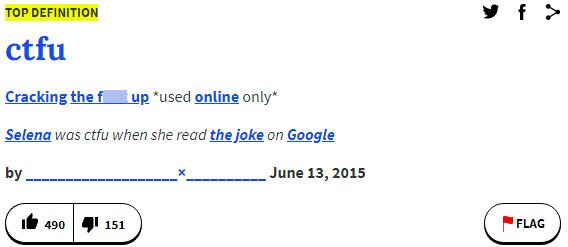
Simply put, the CTFU meaning is internet slang for “Cracking the f*** up.” Yes, that “f” stands for exactly what you think it does.
What Does CTFU Mean?
CTFU is most commonly used on social networking sites when chatting with friends or people you don’t have a professional relationship with.
It’s used to express amusement, similar to ROFL (rolling on the floor laughing), LOL (laugh out loud), or ROFLMAO (rolling on the floor laughing my a** off). Like many internet slang terms, its meaning has evolved through casual online use over the years.
It’s worth understanding that CTFU typically signals a stronger, more intense reaction than LOL, putting it closer in weight to LMAO or ROFL. That said, like most laugh-reaction acronyms, it’s often used non-literally — people reach for it to mark a playful or amused tone in a conversation, not only when they’re genuinely laughing uncontrollably. You’ll commonly see it used in reaction to something funny, ridiculous, or absurd.
That said, its use is fairly limited from a social standpoint, since the “f” in CTFU represents profanity.
It’s also worth noting that, while far less common, CTFU can stand for other phrases, such as:
- “Cut the f*** up,” meaning to let loose or go all out at a party.
- “Cheer the f*** up,” which is telling someone to lighten their mood.
Who Uses CTFU?
CTFU is primarily informal digital slang, and you’re most likely to encounter it in text messages, social media posts and replies, memes, and online communities like Reddit or Discord. Early documented use appeared on platforms like Twitter and older social networks in the late 2000s, and the term still circulates in those kinds of informal, casual spaces today.
That said, CTFU remains noticeably niche compared to mainstream alternatives like LOL or LMAO. Plenty of people who are active online may never come across it at all, depending on which platforms and communities they spend time in. If you do use it, context matters — stick to spaces and conversations where casual, profanity-inclusive slang is already the norm.
Where Does the CTFU Meaning Come From?
There’s no officially known origin of CTFU, but it likely emerged in chat rooms and online forums, much like many modern text-based acronyms.
The CTFU meaning emerged as part of 2000s internet and text-message slang. The term is documented online as early as 2005 on Urban Dictionary, and examples of its use appear on Twitter by 2008 — meaning its recorded internet history now spans roughly 20 years.
Examples of CTFU
Here are some examples of CTFU that may help you decide if you want to use it yourself:
- “Is that video for real? I’m CTFU!”
- “Did you see his Halloween costume? Everyone was CTFU.”
- “I can’t believe how funny your kid is! I was CTFU.”
A Note on CTFU Usage
We’ve covered the question, “What does CTFU mean?” but it’s important to include a word of caution. The profanity in CTFU can be offensive to many people. While strong language is more common today, plenty of people still find it inappropriate.
Avoid using it in formal settings, such as at work, and don’t use it with people you don’t know well—especially if they don’t use profanity or curse words themselves. Similarly, understanding the DW shorthand meaning and other common abbreviations can help you navigate casual conversations more effectively.
When Can I Use CTFU?
As mentioned earlier, CTFU is mostly used as internet slang on social media platforms or public forums. Once you understand the CTFU meaning, knowing when it’s appropriate to use it is just as important.
However, keep in mind that unlike LOL or ROFL, it isn’t widely recognized, so there’s a higher chance of being misunderstood if you use it with the wrong audience.
CTFU can be used as a standalone response, or it can be accompanied by additional comments. Either way, the overall message is the same.
A friendly word of warning: Because CTFU implies you found something extremely funny (such as a comment or a picture), try to avoid using it too often. Overuse can reduce its impact and risk you losing credibility among your peers.
Here’s an example when to use CTFU:
Person 1: Take a look at this funny cat video!
Person 2: CTFU, I can’t believe it!
When Shouldn’t I Use CTFU?
CTFU should never be used in formal conversations with employers or peers with whom you have only a professional relationship.
Because it contains profanity, it’s also best avoided when speaking with people you look up to and respect, such as parents, grandparents, or older relatives.
And just to reiterate, don’t use CTFU unless you genuinely find something very funny. In many cases, LOL or a laughing emoji will get the point across. If you need to exit a conversation quickly, knowing the GTG text meaning can also come in handy.
Here’s an example of when NOT to use CTFU:
Client: We’re unhappy with the work delivered and have decided to pay your firm only $1,000 of the $2,000 originally agreed upon.
You: CTFU!
What Does CTFU Mean? Conclusion
To wrap things up, here’s everything you should know about the CTFU meaning:
- Avoid using it in work environments
- It’s best suited for text-based communication
- It expresses a very high level of amusement
- Don’t use it with people you wouldn’t swear around
- Avoid overusing it unless something is genuinely funny
Hopefully, this guide has clarified when and how to use CTFU in a conversation, and helped you better understand modern internet slang. If you’re curious about other internet slang meanings, there are many more abbreviations and acronyms worth exploring, including the BTFO acronym definition.
If you’d like to learn more about communicating informally online or how to avoid using language at the wrong time, leave us your suggestions in the comments section below.
FAQs
Is CTFU offensive?
It depends on the audience and who you ask. While swearing is fairly common in casual conversation, many people still find the phrase offensive. To be safe, rather reserve it for friends or acquaintances who are comfortable with profanity.
Is there other internet slang similar to CTFU?
Yes, other commonly used internet slang includes:
- LMAO (laughing my a** off)
- ROFL (rolling on the floor laughing)
- LOL (laugh out loud)
- “I am dead” (meaning something is extremely funny)
While these terms are all in the same family, they’re not interchangeable in terms of intensity, profanity level, or how widely they’re understood. LOL is the mildest of the group — universally recognized, profanity-free, and safe to use in almost any casual setting. LMAO and ROFL sit in the middle ground: they convey stronger amusement than LOL, are broadly understood across age groups and platforms, and only carry mild profanity (in LMAO’s case).
The CTFU meaning sits at the more intense, more profane end of the spectrum — it implies a stronger reaction than all of the above, but it’s also the least mainstream and the most likely to confuse or offend. If you’re ever unsure whether your audience will recognize CTFU or be comfortable with its language, LOL or LMAO are safer, more universally accepted substitutes that still get the point across.
How do I use CTFU in texts?
Some examples of using CTFU include reacting to a funny meme or video, using it in a sentence to describe your own reaction, or using it sarcastically in response to an over-the-top request. Like CTFU, understanding NM slang meaning, the NR texting definition, and other common abbreviations like TFTI meaning in text can help you communicate more effectively in casual digital conversations.

Chut the f*** up?