How to Make a Sink in Minecraft
Vanilla Minecraft does not include a standard craftable sink block. The build in this guide is a custom contraption made with redstone, a dispenser, and command blocks that simulate hot and cold water using particle effects. Cooking for Blockheads is a separate Java mod that adds its own kitchen multiblock, including a dedicated sink block that provides a supply of water for recipes — that mod is not what this tutorial covers.
Follow this comprehensive step-by-step guide to build an interactive Minecraft sink and get it right the first time. Whether you are decorating a kitchen or a bathroom, a well-built Minecraft sink adds a realistic touch to any interior build, especially if you are also looking up pet bed crafting steps to furnish the rest of the house.
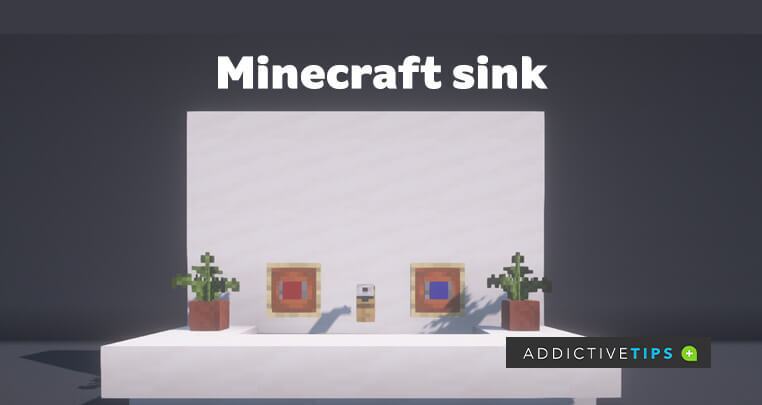
Before you start: Is there a Minecraft sink block in the game?
No, there is no sink block in vanilla Minecraft — Java or Bedrock. Here is a quick breakdown of your options:
- This tutorial (command block build): A custom contraption using a dispenser, redstone, hoppers, and command blocks that fire dripping water and lava particle effects when you press buttons. It looks great but requires cheats or operator permissions and is best suited to Java Edition.
- Cooking for Blockheads mod (Java only): A separate mod that adds a true sink block to your crafting menu. When installed and placed in a multiblock kitchen, it provides water for mod recipes. If you want this, install the mod through CurseForge or Modrinth and craft the sink from its own recipe — you do not need command blocks.
- Decorative sink (no mods, no commands): Stack a quartz stair block facing outward as the basin, place a cauldron or iron trapdoor inside, add a tripwire hook as the faucet, and put a water source block or filled cauldron in the basin. This works in Survival on any edition and looks convincing even though it has no interactive function.
Java, Bedrock, and MCPE compatibility
Before building your Minecraft sink, check which edition you are on so you know what will and will not work:
- Java Edition: Fully supported. The
/particlecommand syntax and command block types used in this guide are written for Java Edition. Cheats must be enabled in your world settings, or you must have operator (OP) status on a server. - Bedrock Edition and MCPE: Command blocks are available but the particle names and syntax differ. For example,
minecraft:dripping_wateris a Java particle identifier; Bedrock uses different effect names. The redstone and dispenser portions of the build transfer over, but the command block commands in Step 15 will need to be rewritten for Bedrock syntax. Enable cheats in your world settings before trying. - Survival mode: This build is not Survival-friendly as written. Command blocks cannot be obtained in Survival without cheats. For a Survival-compatible alternative, use the decorative sink method described in the section above — it requires no commands and works on every edition.
Step 1: Get all the blocks you need for your Minecraft sink
You are going to need the following items to complete this Minecraft sink build:
- Quartz slab
- Dispenser block
- Cobblestones
- Cyan-hardened clay
- Quartz stairs
- Buckets of water
- Tripwire hook
- Stone buttons
- Redstone torches
- Hoppers
- Redstone dust
- Redstone comparator
- Command block
Step 2: Find the area where you want to build
You do not need a vast area to build a bathroom or kitchen sink. Practically, an area of 4×7 blocks will work just fine.
Step 3: Build the wall blocks
Arrange a row of cobblestones 4 blocks high and 7 blocks wide. These blocks will make the sink look clunky. But that is alright since there is no way to make thin blocks. If you decide to swap in other stone-based variants for the surround, learning stonecutter block use can help you make matching stairs and slabs more efficiently. If you want to make a colorful sink, replace the three cobblestones in the middle of the base of the wall with Quartz slabs, and if you are adding a window or divider nearby, this guide to crafting glass blocks can help complete the room.
Step 4: Arrange quartz stairs.
Select quartz stairs in the inventory and arrange them in two rows to form a cage around the 1st and 2nd block and the 6th and 7th cobblestone at the base level.
Step 5: Dig the area
Select an iron shovel and dig the area around the sink to form a pit not more than one block deep.
Step 6: Fill up the pit
Fill up the depth of the pit with cyan-hardened clay. At this point, you will see that the sink is already forming a great shape.
Step 7: Build the water pit
Dig out the grass in the center of the sink area — the cage-like area formed by the quartz stairs. Make it one block deep and three blocks wide.
Step 8: Place the dispenser for your Minecraft sink
Place a dispenser block in the dug-out area so that its output face points upward toward the basin opening. The dispenser is what will hold and eject water when triggered by the redstone circuit.
Make sure it is facing up — right-click to open it before wiring anything so you can confirm the direction. Fill the remaining space around it with three slab blocks to complete the basin surface.
Step 9: Load the dispenser with water
Right-click the dispenser to open its inventory and place water buckets inside. When the dispenser fires, it will place a water source block above it. Note that this Minecraft sink build also uses particle effects (set up in Step 15) to simulate dripping hot and cold water above the faucet. The dispenser handles the actual water source block; the command blocks handle the visual particle effect.
Step 10: Create hot and cold water taps
A modern kitchen or bathroom sink should have a functional tap that runs hot and cold water. To do that, place a trip-wire hook in the middle area above the dispenser — just like you have it in a real-life sink. After that, grab two button blocks and place them on the left and right sides of the trip-wire hook.
Step 11: Create a command block
To make the buttons interactive, you need to obtain a command block. Command blocks cannot be crafted — you must use a chat command to give one to yourself. Open the chat window and type the following command exactly:
/give @s command_block
Hit Enter. This works in Java Edition when cheats are enabled in your world settings. On a server, you must have operator (OP) status. If the command does nothing, open your world settings and confirm that cheats are turned on before trying again.
Step 12: Arrange Redstone torch
Go behind the sink and place one Redstone torch each behind the buttons.
Step 13: Equip hoppers
Place two hoppers beside each torch. Ensure that the hoppers are closely connected. After that, place Redstone dust on top of each hopper. Then place a Redstone comparator directly behind or beside each hopper, with the comparator’s output end pointing away from the hopper toward the command block. Comparators cannot be placed inside a block — they sit on the ground adjacent to the hopper.
Step 14: Place command blocks at the end of each comparator.
Change the formatting of the command block after arranging them at the end of the comparator. Right-click on the command block and press the “impulse” button to change it to “repeat,” then press “done.” Doing this will change the color of the command block to purple.
Step 15: Activate the command in the command block
Once you have changed the configuration of the command block from “impulse” to “repeat,” right-click on your command block and paste the following command for the command blocks on each side. These commands fire dripping water and dripping lava particle effects to simulate cold and hot water above the faucet — they do not create actual flowing water.
Choosing the right set of commands: The coordinates in each command are relative (~) to the command block’s own position. Before pasting a command, stand behind your Minecraft sink and note which direction the faucet faces. In Java Edition, press F3 to open the debug screen — the “Facing” line tells you which cardinal direction you are looking. The sink faces the same direction you are looking at it from the front. Pick the matching set below. For more Minecraft redstone commands, see our guide, and for a full reference on particle command syntax, see the official Minecraft Wiki page on particles.
North Side
[1] /particle minecraft:dripping_lava ~-2 ~0.85 ~3.90 0.02 0.02 0.02 0 3
[2] /particle minecraft:dripping_water ~2 ~0.85 ~3.90 0.02 0.02 0.02 0 3
East Side
[1] /particle minecraft:dripping_lava ~-3.90 ~0.85 ~-2 0.02 0.02 0.02 0 3
[2] /particle minecraft:dripping_water ~-3.90 ~0.85 ~2 0.02 0.02 0.02 0 3
South Side
[1] /particle minecraft:dripping_lava ~2 ~0.85 ~-3.90 0.02 0.02 0.02 0 3
[2] /particle minecraft:dripping_water ~-2 ~0.85 ~-3.90 0.02 0.02 0.02 0 3
West Side
[1] /particle minecraft:dripping_lava ~3.90 ~0.85 ~2 0.02 0.02 0.02 0 3
[2] /particle minecraft:dripping_water ~3.90 ~0.85 ~-2 0.02 0.02 0.02 0 3
This should activate the redstone behind each button. Now, go to the front of the sink and toggle on the cold and hot tap to confirm if it works.
Troubleshooting checklist:
- Particles appear in the wrong spot: You likely used the wrong directional command set. Check your facing direction with F3 and swap to the correct set.
- Buttons do not trigger anything: Confirm your redstone dust forms an unbroken path from the button to the torch and from the torch to the hopper and comparator. A single gap will break the circuit.
- Command block stays on Impulse and will not fire continuously: Right-click the command block, click the “Impulse” button until it reads “Repeat,” then click Done. The block should turn purple.
- Command block does nothing at all: Cheats are likely disabled in your world or you lack operator permissions on a server. Exit to the main menu, edit your world settings to enable cheats, and re-enter the world.
- No particles show up even though the circuit fires: Make sure your in-game particle setting (Video Settings > Particles) is not set to Minimal or Off.
Wrapping up your Minecraft sink build
So that’s how you build a fully functional Minecraft sink. Why don’t you give it a try and let us know if it works for you in the comment section? You can even use Minecraft color codes to create color-coded signs for labeling bathroom fixtures or organizing modded kitchen stations. If you’re trying to play Minecraft at school or work, don’t forget to check out our guide on Minecraft unblocked at school. Additionally, you can request any Minecraft tips and tricks of your choice, and we will get on it.