Windows 7 System Temperature Monitor
We have reviewed apps, such as, Speccy that give detailed information of the system. But what if you want check the hardware after building your own custom Windows 7 system? HW Monitor is a portable tool which lets you monitor your computer’s hardware. It is a monitoring program that reads the systems main health sensors like voltages, temperatures, fan speed, etc.
Does Windows 7 Have a Built-In Temperature Monitor Like HW Monitor?
Windows 7 does not include a reliable built-in CPU or system temperature monitor in the normal desktop interface. There is no native tool in Windows 7 that surfaces CPU, GPU, or motherboard sensor readings on the desktop. While some motherboard manufacturers do expose sensor data through WMI (Windows Management Instrumentation), this support is inconsistent across different hardware configurations, which means a dedicated monitoring application is the simplest and most reliable option for most users.
You can also check your BIOS/UEFI hardware monitor page at startup for a basic temperature snapshot, but that only gives a static reading rather than real-time data under load. For live monitoring, a third-party tool such as HW Monitor, Open Hardware Monitor, or Core Temp is the practical choice.
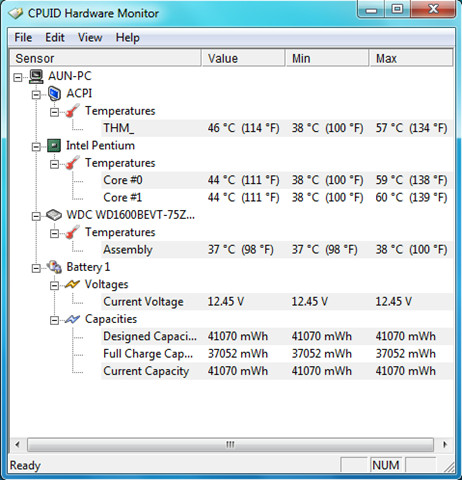
This is a very simple tool, just run the executable file and it will show you the results. Once the application launches on your Windows 7 PC, it organizes sensor data into clearly labeled categories for each hardware component. Here is what you can typically expect to see:
- CPU package and per-core temperatures — reported using on-die thermal sensors built into modern processors
- GPU temperature — the video card’s core temperature
- Motherboard sensors — chipset and ambient temperatures where the board supports them
- Fan RPM readings — for the CPU cooler, chassis fans, and other connected fans
- Voltages — CPU core voltage, VIN rails, and other power-related readings
- Hard drive and SSD temperatures — pulled via S.M.A.R.T. data
- Clock speeds and utilization — on supported processors
- Power and current draw — on platforms where sensor data is available
- Battery thermal readings — on laptops where supported
All values are displayed as three columns — current, minimum, and maximum — which makes it easy to spot temperature spikes that occurred during heavy load even if you check back after the fact. Monitoring these temperatures is especially important if you’ve recently upgraded or installed a new processor, and if you’re concerned about thermal performance, our CPU cooling guide can help you choose the right cooling solution for your system.
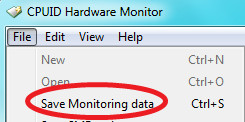
You can save the monitoring data, click the File > Save option and then specify the location where you want to save the file. This generates a plain-text report of all current sensor readings, which is useful for troubleshooting hardware issues or sharing with technical support.
Alternatives to HW Monitor for System Monitoring
This tool is a solid all-round choice, but there are a few other utilities worth knowing about depending on what you need:
- Open Hardware Monitor — A free, open-source option that covers most of the same sensor categories as HWMonitor, including CPU, GPU, motherboard, fan, and drive temperatures. It also supports a system tray display and a desktop gadget-style overlay, making it a good pick if you want temperatures visible at a glance without opening the main window. It is the best alternative for users who prefer open-source software or want built-in logging.
- Core Temp — A lightweight, CPU-focused tool that reads per-core temperatures using Intel and AMD digital thermal sensors (DTS). It has a very small footprint and is the best choice if you only care about CPU temperatures and want the simplest possible interface. It is not a full-system monitor, but it does the CPU job extremely well.
- Real Temp — Another CPU-only monitoring tool designed specifically for Intel processors. It is a reliable second opinion if you want to cross-check your CPU readings and is particularly useful for older Intel Core architecture chips common in Windows 7 systems.
In short: use HW Monitor or Open Hardware Monitor when you want full-system monitoring across CPU, GPU, drives, and motherboard sensors. Use Core Temp or Real Temp when you only need a quick, accurate look at CPU temperatures.
It also works on Windows XP and Windows Vista, apart from Windows 7.

It is a great software. It shows temperature of two CPU cores, hard disk and also two mainboard sensors. Thanks a lot.
A little idea on feature: how about let the program able shrink to the status tray when minimized or “X” is clicked?
hm.. i didn’t agree with some things, however i do liked it overall… this post was recommended to me by a friend at digg and he was right though. quite good read! 🙂
You’re right, I’m a noob and was looking for a hardware temp monitoring tool for Win7. After preforming a google search it led me straight here. Good job with the title and thanks for the help, this is just what I needed.
Great application indeed. I have been using it since installing Win7.
I use HWMonitor in conjunction with HWMonitor Meter and HWMonTray to monitor core temps,HDD temp,% CPU used and % RAM used in a small 3/4×1-1/2 rectangular window on my desktop.I created a run-at-startup and log-on command so that it is completey hands free.It’s a wonderful tool and I have recommended it to several friends.
For the whiners-You got to this site because you were looking for a hardware monitor for your PC.You found it….
No I actually came to this page from google under the impression I was going to be shown how to use the in-built performance monitoring tools that comes with windows 7 to provide a logfile of temperatures from various system components.
Instead, we get a recommendation for a program that requires launching and doesn’t provide a Service to create log-rotated data.
It doesn’t matter however, because we’ll have to resort to using WMI in order to code our own temperature log server.
I needed a utility to monitor the temperature of my new Hex core processor and ATI 5770 graphics card, components of my new build. I typed in temperature monitor Windows 7 and found this – exactly what I was wanting top of the list.
Considering the amount of junk that you have to wade though on web searches this was a dream, and the utility is superb – simple and totally effective.
I just don’t understand some people. You give great stuff away for free and they still find something to bitch about.
Thanks.
boo and alex,, wrong wrong wrong! nakodari is right! i went to search for a system monitor with temperature and the search took me right here. i downloaded it and it worked fine. if you morons dont like it then move on, instead of bitching like old women! thanks, nakodari.
the title of this article is contradicting/confusing/false.. I clicked to this article because I was expecting another built-in feature in Windows 7 which I've yet to come across.. sadly it's just another 3rd party software that does the info-monitoring.. nothing gonna do with Win7.. I can simply copy this exact article and re-title as “Windows Holy Version Platinum System Temperature Monitor”, which has the same meaning as yours..
I believe that you got somewhat confused here. I wrote this basic title to help the beginners find the temperature monitoring tool. How else would they find it?If you do know any other tool why not share with us? Sadly, Windows 7 doesn't have a solid build-in temp monitoring tool. So next time users will search for a good tool to monitor temp in Windows 7, they will find the tool mentioned above useful. I hope it clears the confusion.On the other hand we provide short excerpts of the post on the main page which pretty much shows the tool name. So if you think it is a 3rd party tool, you don't need to click the article. 😉
boo has got a point. You could have used a better title like “System Temperature Monitor for Windows 7”
Who cares you winnie stupid bitch
WTF???? Why don’t you step off you Bitch! I said that was the tool but now I found you to be a tool.
Great application indeed. I have been using it since installing Win7 RC back in may.I tried every temperature gauge I could find and this one is by far the best that I could find. Highly recommend.
Its the monitor I use, great application!