Use AI at Work: Tips & Tools for Smarter Productivity

If you’re wondering how to use AI at work, you’re not alone. By now you’ve probably heard that AI can do all kinds of tasks for you in the workplace — maybe even replace workers entirely. However, if you’re not very savvy yourself yet, you may be wondering how exactly it can help. We’ve put together a list of ways in which you can use AI at work and hopefully become more productive.
When to Use AI vs. When to Keep a Human in Charge
Before diving into specific use cases, it helps to know which tasks are actually a good fit for AI in the first place. Not everything belongs in a chatbot, and making that distinction early will save you time, frustration, and potential headaches with your employer.
A useful starting point is to sort your recurring work tasks into three buckets:
Bucket 1 — Tasks AI can handle on its own: These are routine, low-stakes, rule-based activities where the output doesn’t require much judgment. Think formatting documents, summarizing meeting notes, extracting data from files, scheduling reminders, or generating first drafts of templated emails.
Bucket 2 — Tasks AI can assist with: These benefit from AI involvement but still need you to guide, review, and refine the result. Examples include drafting reports, brainstorming ideas, preparing talking points for meetings, analyzing data you’ve provided, and researching background context.
Bucket 3 — Tasks that should stay human-led: These require judgment, sensitivity, or accountability that AI cannot reliably provide. Performance reviews, HR issues, stakeholder negotiations, ethical decisions, legal sign-offs, and anything that becomes final and official should always have a human in charge. AI can support the preparation work, but the decision itself belongs to you.
It also helps to understand the difference between two related concepts. Automation means handing a task off to AI to complete independently — useful for repetitive, low-risk work. Augmentation means using AI as a collaborator to make your own work faster or better — more appropriate for complex or sensitive tasks where your expertise still drives the outcome.
Before using AI on any task, run through this quick checklist:
- Is it repetitive or rule-based?
- Is it low-stakes if the output contains a small error?
- Does it require up-to-date facts, company-specific context, or nuanced judgment?
- Does it involve confidential data, personal information, or anything regulated?
If a task is repetitive and low-stakes, AI can likely handle it alone or with light review. If it requires current facts, internal knowledge, or careful judgment, treat AI as an assistant rather than an authority. If it involves confidential data, proceed with serious caution — more on that below.
The best way to build confidence is to pick one low-risk task and use AI for it consistently over one to two weeks. Document what worked, what needed correction, and how much time you saved. That gives you something concrete to build on before expanding further.
Automating Tasks: How to Use AI at Work More Efficiently
The first and foremost way AI can help you is by automating tasks. If you have any kind of office job, there’s likely a number of things that you do every day which could be done a little quicker by a computer. You just either haven’t thought about it yet, or you’re not sure how to do it.
This is where artificial intelligence shines, easily performing any number of tasks that leave you scratching your head. A good example is email management, which before would involve either using an add-on in Outlook or Gmail, or even use of a custom script coded in Python. Tricky operations out of reach for a lot of people.
Until now, that is. With minimal work from you (and some customization), you can ask ChatGPT to not only sort emails for you, but even automatically reply with form responses to certain emails. For example, you can have it send something along the lines of “we’ve received your email and will get back to you in 24 hours,” to even just simply replying to certain annoying senders that their request is under advisement. It’s up to you, the AI won’t judge — though your boss might.
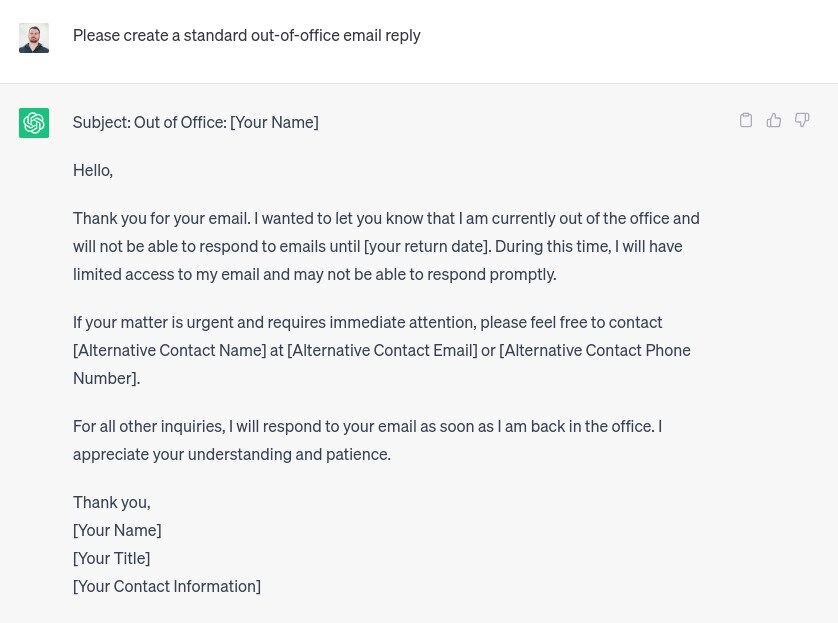
It’s not just emails, either: ChatGPT can also be used to automate certain aspects of your calendar, like managing recurring tasks, setting reminders, and cleaning up unneeded entries. If you spend as much time clearing up your calendar as we do, that’s a godsend.
Data Entry
As cool as automation is, even more interesting are the many ways in which AI can help you manage data, especially when it comes to input. One of the biggest banes of almost any office job is the fact that different formats of files don’t work with each other, meaning a lot of grunt work even for mid-level employees.
For example, it’s very hard to take the text from a PDF file and have it exported to a Word document. Let’s not get started on the many issues you will have when confronted with paper records.
AI is the answer to all these issues. Any AI worth its salt can read practically any document and then give you an output in whatever format you’d like. All you need to do is tell it what to do and you’re pretty much good to go. It’s really fantastic, and a massive timesaver.
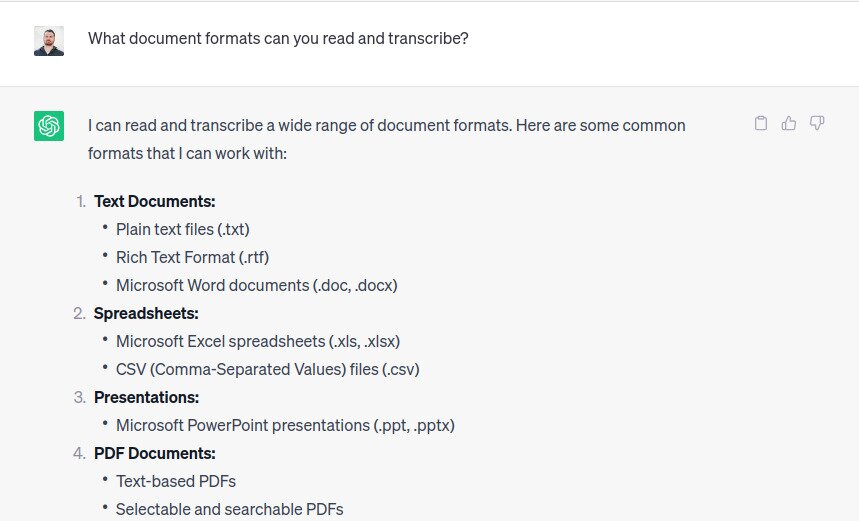
What makes it even better is that with the help from AI you can then manipulate this data more easily than ever before, like entering it into tables, creating visualizations, the lot. What once was the domain of data scientists now can be done by almost anybody — though you may want to get an expert to vet your work as AI can be unreliable.
Writing
Naturally, a great way to use AI in any setting is as a way to improve your writing, or even have it write for you. For example, you can have it put together non-essential emails, like we recommended earlier, or have it knock together a simple report or two.
There are several ways in which ChatGPT or other AIs can help you write: you can ask it for an outline of an article based on existing work so you have a blueprint to work with, for example. This is very handy if you’re new to a subject or even just need some guidance on how to start an article.
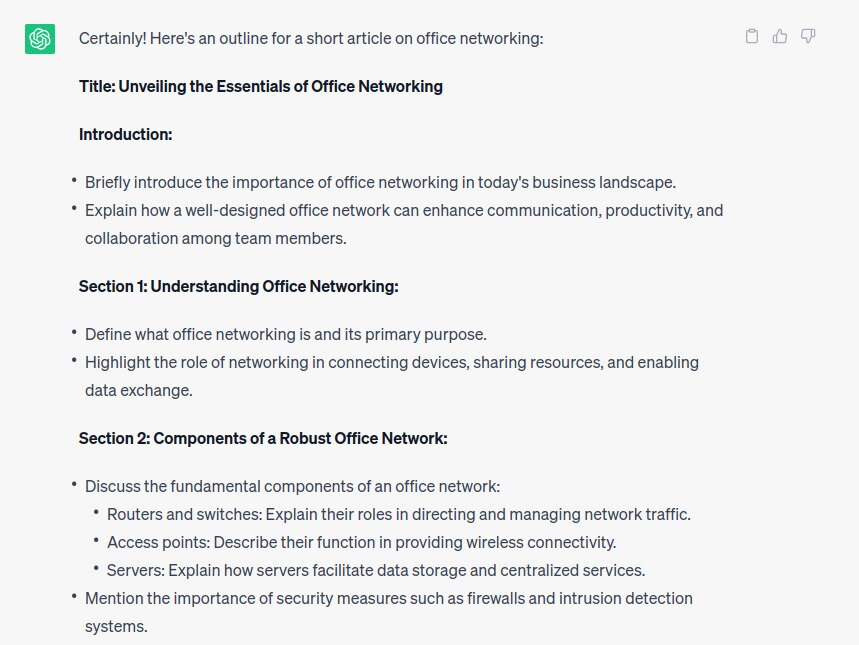
Naturally, you can also ask for an outline for a presentation, a memo, or pretty much anything else related to the modern office environment. Examples abound, and you can save yourself a lot of time.
ChatGPT is also a great tool if you want to check something you’ve written. No matter if you’ve written an email, presentation or full-length article, you can feed it to ChatGPT and have it come back with suggestions for improvements.
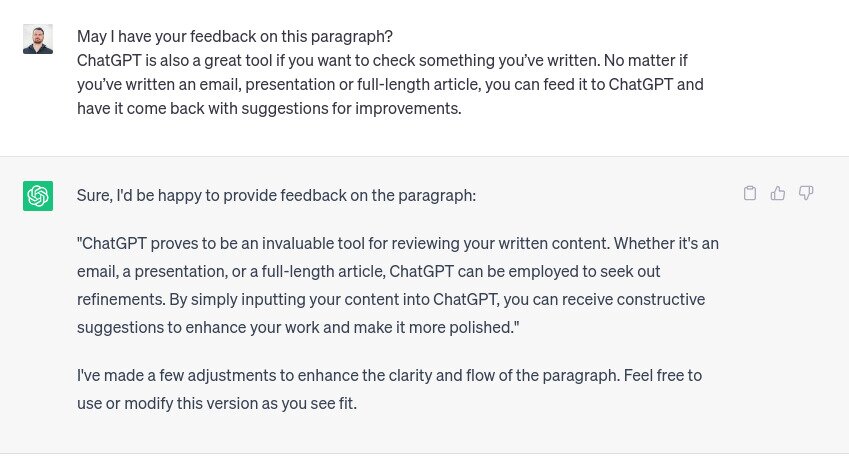
You’ll find, though, that we recommend keeping things simple. The more complicated you make your prompts, or the more you put on ChatGPT’s plate at any one time, and the worse the outcome will be. We don’t recommend having it write up outlines for entire books in detail, for example.
Also, be extremely wary of having an AI write entire articles for you: even with extensive editing from you after the fact, it’s extremely easy to detect and will likely land you in trouble with your boss. Fact is, that even at its best AI is unreliable and you should always check its work, whether it’s written an article for you or even just an outline: double check it gave you what you asked for.
Research: Another Key Way to Use AI at Work
Nowhere is this need to verify more present than with our last entry, namely having AI help you with doing research. Finding out how things work is an integral part of any modern job and, just like in school, AI can be an amazing assistant.
However, there’s an issue, namely so-called hallucinations, which is when an AI simply makes stuff up. It’s a little unclear why it does this, and newer iterations of most bots do it less — when comparing GPT-3.5 with GPT-4 there’s a marked decrease — but it’s a pretty serious issue that you need to be aware of and calculate into whatever you’re doing.
How much checking you do should match the risk level of the task. For internal, low-stakes work, a quick logic and relevance check is usually enough — does the output make sense, and does it actually answer what you asked? For anything external-facing or high-stakes, such as a client report, a published article, or a policy brief, you need to verify every statistic, date, quote, citation, and policy claim against primary sources before it leaves your desk.
A practical four-step review process to apply to any AI-generated research output:
- Sense check: Read through and ask whether the information is plausible and internally consistent. Flag anything that sounds surprising or overly convenient.
- Source check: If the AI cites a source, look it up directly. Confirm the source exists, says what the AI claims, and is credible.
- Number check: Verify every figure, percentage, date, and statistic independently. AI tools frequently get numbers wrong even when the surrounding context is accurate.
- Expert review: For specialist topics — legal, financial, medical, technical — have a qualified person review the output before it’s used or shared.
A useful prompt pattern to reduce hallucinations during research tasks is to provide your own source material and instruct the AI to work only from it: “Use only the sources I provide below, quote them directly where possible, and clearly label anything you are uncertain about.” This keeps the AI grounded in material you can actually verify.
The result is that you can use AI to guide your research, but it can never do the research for you. For example, you likely shouldn’t ask the bot a direct question like “tell me about interest rates” since that may lead to some odd information. Instead, you can ask it for resources, like books.

Note that tools with web browsing or connected-document features — such as Google Gemini or Auto-GPT — can be better suited for tasks that require fresher information than a model’s training data covers. ChatGPT also supports web browsing in many current versions and workplace configurations, though whether that feature is available depends on the model, your subscription plan, and any admin settings your employer has in place. Whichever tool you use, always verify the cited sources manually rather than trusting the AI’s summary of them.
Another great way to have AI help with research is to ask it to set out a course for you, which you can then use to study in your own time. Though this likely won’t help if you need to put something together for a presentation next week, if you’re invested in improving your skills over the long term, it’s ideal.
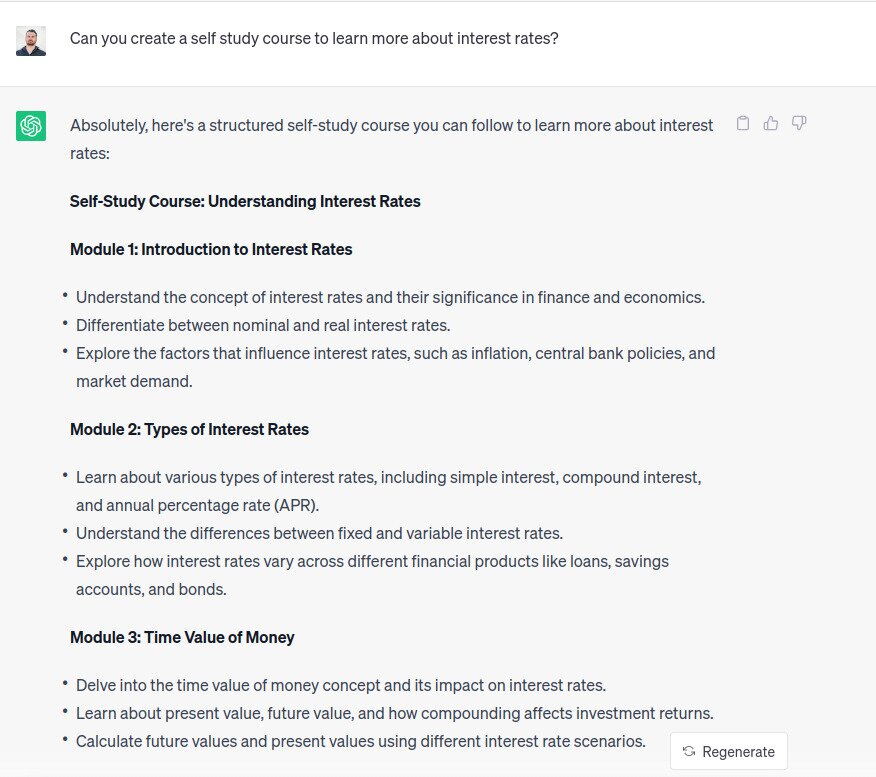
Again, you may want to double check everything that the chatbot says, but it’s a great way to get started with whatever you’d like to do.
Using AI at Work Safely: Privacy, Confidentiality, and Company Policy
Knowing how to use AI productively at work is only half the picture. The other half is knowing what not to put into it — because once information leaves your device and enters a third-party AI tool, you may have very limited control over what happens to it next.
As a firm rule, never paste the following types of information into a public or consumer AI tool:
- Customer personally identifiable information (PII) such as names, addresses, email addresses, or account numbers
- Employee records, performance data, or HR documentation
- Contracts, legal drafts, or documents under attorney-client privilege
- Unreleased financial data, earnings figures, or forecasts
- Login credentials, API keys, or security tokens
- Proprietary source code or internal technical architecture
- Internal strategy documents, acquisition plans, or competitive intelligence
Before using any AI tool for work tasks, check whether your employer has a policy on approved tools. Many larger organizations have licensed enterprise versions of AI platforms — such as Microsoft Copilot integrated with Microsoft 365, or ChatGPT Enterprise — that are configured with stricter data handling and privacy controls than the free consumer versions. If an approved tool is available, use that instead of a general-purpose chatbot.
If you are using a consumer tool and need to work through a scenario that involves real data, anonymize it first. Replace real names with placeholders, swap out account numbers for generic labels, and remove any detail that could identify a person, client, or internal project.
Here is a simple example of what a safe, anonymized prompt looks like compared to a risky one:
Risky prompt: “Write a follow-up email to John Smith at Acme Corp regarding the $240,000 contract renewal we discussed on Tuesday.”
Safe prompt: “Write a follow-up email to [Client Name] at [Company] regarding a contract renewal discussion we had earlier this week. Keep it professional and brief.”
The safe version gives the AI everything it needs to produce a useful draft without exposing any real names, relationships, or financial details.
Finally, be aware that free consumer chatbots may handle your submitted data differently than enterprise-licensed tools. Terms of service vary and can change. When in doubt, treat any public AI tool as a public space — and only share what you would be comfortable with others seeing.
How to Use AI at Work: Final Thoughts
AI is a wonderful tool to help you save time at work while also improving your own productivity. Understanding how to use AI at work effectively means knowing both its strengths and its limitations. The tips above are just a few ideas to help you get started; there’s literally no end to all the things chatbots can help you do at work. Just remember to not rely on them too much and check what they’re doing, and you’ll likely have a much easier day at work.