Great Farm ideas in Minecraft
Exploring the substrates and boondocks in Minecraft can be a fun way to get acquainted with the game’s vast open world. Still, you’ll find this adventure tiring sometimes, especially if your reason for doing it is to mine the much-needed items for your survival. Building smart minecraft farm ideas into your world early on can save you all that stress, allowing you to pick up the materials you need to beef up your survival on the go.
You can make many things from these materials, from Minecraft armor to brewing Minecraft potions. If you’re new to the farming mechanics in Minecraft, you’ll find the farm ideas below helpful in becoming self-sufficient in the game. You can also explore growing mushrooms in Minecraft for another simple way to stock up on useful resources.
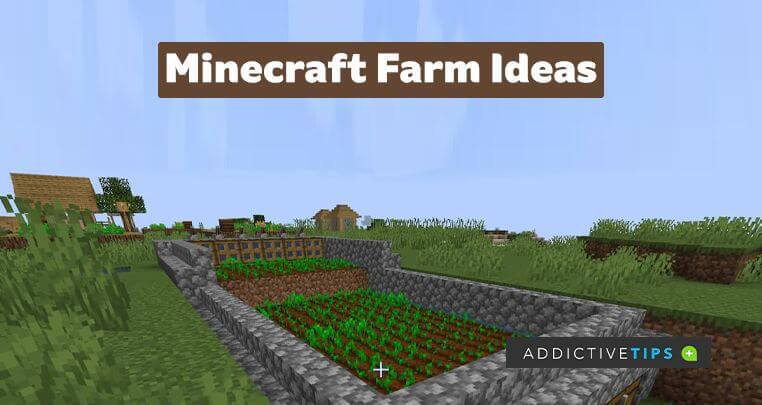
Starter Minecraft Farm Ideas for Survival
Before diving into automated and late-game builds, it helps to get a handful of simple farms running early. These beginner-friendly setups give you a steady supply of the resources you need most, without requiring complex redstone or hard-to-find materials.
Crop Farm (Wheat, Carrots, Potatoes)
A basic tilled-soil plot planted with wheat, carrots, or potatoes is the cornerstone of any survival world. These crops keep you fed and give you trading stock for villagers. To get started you need just a hoe, water source, and seeds — all available within your first day. Difficulty: very easy.
Animal Pen (Cows or Sheep)
Fencing in a pair of cows gives you a renewable source of beef, leather for armor and books, and milk for clearing status effects. A sheep pen does the same for mutton and wool. Both setups need only fencing, a gate, and two animals of the same type to breed. Difficulty: very easy.
Sugar Cane Farm
Sugar cane grows automatically next to water and produces sugar for potions and paper for maps, books, and trading. A simple row of cane planted along a riverbank or water channel is all it takes. Harvest by hand or add an observer-and-piston setup when you’re ready to automate. Difficulty: easy.
Bamboo or Tree Farm
Bamboo is one of the fastest-growing plants in the game and provides a compact fuel source for furnaces as well as scaffolding material. A small tree farm — even just a row of saplings with enough space above them — keeps you in wood without wandering far from base. Difficulty: easy.
Cactus, Berry, or Flower Farm
A cactus farm placed over a hopper and chest collects green dye and experience passively. Sweet berry bushes are an extremely low-effort food source that grows on their own once planted. A small flower patch gives you dyes for banners, beds, and decorative builds. All three are set-and-forget options for early game. Difficulty: easy.
Farm Design Ideas by Style
Not every player farms purely for output efficiency. Sometimes you want your base to look the part. Here are six layout concepts that blend function with visual style, whatever your base aesthetic might be. Each of these minecraft farm ideas can be adapted to suit your preferred biome and building materials.
Greenhouse Farm
A glass-enclosed structure that houses crops, flowers, or saplings in a controlled environment. Best for players who want a tidy, organized farming area near their main base. Pairs well with crop farms and mushroom farms. Works in any biome but looks especially striking in snowy or desert settings.
Barn with Animal Pens
A classic wooden barn divided into separate fenced sections for cows, sheep, pigs, and chickens. Best for players building a homestead or village-style base. Pairs naturally with a hay field out front for a complete farm aesthetic. Suits plains and meadow biomes.
Vertical or Multilayer Crop Farm
Stack multiple crop layers on top of each other, using water streams on each floor to channel drops to a central collection point. Best for space-limited bases or players who want high output from a small footprint. Works well in underground or sky-base builds.
Walled Medieval Farm
A stone or cobblestone perimeter wall enclosing organized crop rows, pathways, and a small well or fountain at the center. Best for players building a castle or village aesthetic. Pairs well with wheat, carrot, and potato plots, plus decorative flower borders. Suits temperate biomes like plains or forest.
Orchard or Vegetable Patch
An open-air arrangement of fruit trees (using oak, apple-dropping trees), berry bushes, and crop rows laid out in neat lines with dirt paths between them. Best for a rustic countryside look. Pairs well with sweet berry farms, pumpkin and melon patches, and flower beds.
Windmill or Silo-Centered Farm Layout
Build a tall windmill or grain silo as the visual focal point of your farming area, with crop fields radiating outward from it. Best for players wanting a statement build that also functions as a storage hub. The silo structure can house chests and hoppers for centralized collection, pairing well with automated crop and animal farms.
Chicken Cooking Farm
What’s more relaxing than sitting back watching your chickens get butchered and cooked with just a simple flick of a switch? This method saves you the stress of being a Minecraft vegan. With this farm, all you have to do to sustain it is to breed more chickens. You will, in turn, get cooked meat, feathers, and a self-sustaining flock from this automated process. It’s one of the most satisfying minecraft farm ideas to set up mid-game.
What it produces: Cooked chicken (reliable food source) and feathers (used for arrows and book-and-quill). Progression: Mid-game — you need hoppers, a chest, a lava source, and a dispenser or slab setup, none of which are available on day one. Prerequisites: Chickens or eggs, hoppers, a chest, slabs or a dispenser, and a lava bucket. Java or Bedrock: Works on both editions with minor layout differences.
Common mistake: Not maintaining the egg supply — without a steady stream of eggs hatching into chicks, the farm will run dry. Keep a separate egg-laying area attached to the main killing chamber to keep the population self-sustaining.
Automatic Wool Farm
Setting up this farm is your best chance of stocking up on all different types of wool colors available in Minecraft. If you’ve ever created the bee crop farm, you’ll have no problem setting this one up as there are some similarities. However, you’ll need a glasshouse to maintain this farm, as that’s where you’ll be sheltering the sheep. The sheep will produce all the wool you’ll ever need to make items such as carpets, beds, and even paintings, especially if you’re planning a Minecraft pet bed build.
What it produces: All 16 colors of wool (dye your sheep beforehand to get specific colors), plus mutton if you choose to cull the flock. Progression: Early to mid-game — you can build a simple manual shearing pen almost immediately and automate it once you have observers and dispensers. Prerequisites: Sheep, grass blocks, shears (for manual), or observers, pistons, and a dispenser with shears (for automated). Java or Bedrock: Works on both, though some redstone shearing contraptions behave slightly differently between editions — check your build is edition-tested.
Common mistake: Forgetting that sheep must eat grass to regrow their wool. If the floor of your pen is dirt or stone rather than grass, your sheep will produce wool only once and then stop until they find a grass block to graze on.
Shulker Shell Farm
Shulkers were added to Minecraft long before the Caves and Cliffs update — they arrived with the End Cities in the Cities and End update (Java 1.9 / Bedrock equivalent). What changed in more recent versions is that shulkers can duplicate under specific conditions, making renewable shulker shell farming possible for the first time. This farm takes advantage of those newer duplication mechanics to let you collect as many shells as you need with little ongoing effort, but it is firmly a late-game build since it requires full access to the End and End Cities.
What it produces: Shulker shells, which you combine with chests to craft shulker boxes — the most portable and space-efficient storage in the game. Progression: Late-game only. You must have defeated the Ender Dragon, navigated to an End City, and looted at least one Elytra or have reliable armor before attempting this.
Prerequisites: End access, End City location, strong armor and weapons, and a working knowledge of the shulker duplication mechanic for your version. If you want a combat refresher before heading into the End, take a look at the best weapons for mobs. Java or Bedrock: Primarily Java; shulker duplication mechanics work differently or may not apply in the same way on Bedrock, so confirm your farm design is tested for your edition. Common mistake: Attempting this farm before you have adequate gear — shulkers levitate you and deal consistent damage, so entering an End City unprepared will cost you progress fast. Follow the step-by-step tutorial below for a reliable build.
Iron Farm
Iron is arguably the most essential resource in Minecraft as far as survival is concerned. Setting up a dedicated iron farm — one of the most practical minecraft farm ideas in the game — lets you source all the materials you’ll need for your armor and gear. This is especially useful if you’re also planning around a beacon materials list. Keep in mind that this iron farm is a temporary one, and how long it will serve largely depends on your server setup.
What it produces: Iron ingots and poppies — iron is essential for tools, armor, rails, hoppers, and dozens of crafting recipes throughout the entire game. Progression: Mid-game. You need villagers, beds, and a way to keep them scared (typically a zombie or other hostile mob in a controlled area) to trigger iron golem spawning. According to the official Minecraft Wiki, iron golems spawn naturally in villages when certain population and bed thresholds are met, making villager management a key part of this farm.
Prerequisites: At least three villagers with beds and a workstation each, a zombie or pillager as a threat source, and a lava or cactus collection system to kill the golems. Java or Bedrock: Works on both editions, but the spawn mechanics differ significantly. Java relies on village detection and a linked threat; Bedrock has its own golem-spawn rules that require a specific villager-to-bed ratio. Make sure the tutorial you follow is tested for your edition. Common mistake: Using a farm designed for the wrong edition — a Java iron farm built on Bedrock (or vice versa) will produce little to no iron because the golem-spawn conditions are different between versions.
AFK Fish Farm
This is a specialist farm, and the importance of owning one cannot be overemphasized. Thankfully, setting it up is pretty hassle-free as it requires just a few resources. However, if you intend to make the most of the fishing shack, your best bet is to upgrade your fishing rod. In addition, you can fit in as many items as you want in the basement if you use the expansion option.
Important version caveat: Classic one-block AFK fish farms — the kind that use a small enclosed water pool — no longer award treasure loot in modern Java Edition. Since Java 1.16, the game requires open-water fishing (a 5x5x1 area of water with no obstructions above or nearby) to unlock the treasure loot table, which includes enchanted books, name tags, saddles, and nautilus shells. If you build a confined one-block AFK farm on modern Java, you will only receive fish and junk — no treasure. For treasure farming on Java, you need an open-water design.
What it produces: Fish (food), junk items, and treasure (enchanted books, name tags, saddles — open-water only on modern Java). Progression: Early to mid-game once you have a fishing rod, though a Luck of the Sea–enchanted rod significantly improves your yield. Java or Bedrock: The open-water requirement applies to Java Edition. Bedrock Edition has different fishing mechanics and does not enforce the same open-water rule, so compact AFK fish farms can still yield varied loot there. Common mistake: Building a confined AFK farm on modern Java and expecting enchantment books or name tags — you will be disappointed. Use an open-water setup if treasure loot is your goal, and confirm the tutorial you follow specifies which edition and version it was designed for.
Best Minecraft Farm Ideas: Final Notes
There you have it — some of the coolest minecraft farm ideas to try in your world. The game never gets stale as there is still a lot more to discover and build. You just have to explore and ransack every nook and cranny for full immersion into the Minecraft world. To organize your farms more clearly, you can also use Minecraft color codes to customize sign text for crop types, storage areas, or automation zones. If you’re trying to play at school or work, be sure to check out our guide on Minecraft unblocked at school to help you stay connected and creative wherever you go.
You may also want to learn about the underground farm in Minecraft. Enjoy!