Lightbeam For Firefox Generates A Graph Of How Websites Track You
Lightbeam for Firefox is a powerful browser add-on that helps you understand how websites track your online activity. If you’re a tech savvy internet user, you’re likely aware that the websites you visit might track your browsing habits in order to present you with information custom-tailored to you. While browsing the web, the digital footprint you leave behind is used by advertisers to discover what your interests are, and in turn, lets them display context and interest-based advertisement on websites you visit.
But recently, online transparency has become a highly debated issue after shocking revelations of NSA’s project PRISM, which involved many tech giants providing the National Security Agency with access to your private data. In the wake of it, Mozilla released Lightbeam for Firefox that aims to help illuminate invisible connections that intervene in your digital life. It reveals information to you about third-party sites that are watching your online activities as you browse.
Current Status, Support, and Availability
Lightbeam has a longer history than most privacy add-ons. It originally launched under the name Collusion before Mozilla rebranded and released it as Lightbeam around the time of the PRISM revelations. Mozilla later ended its official support for the extension after Firefox introduced built-in tracking protection and enhanced privacy reporting features of its own.
Today, Lightbeam lives on as a community-maintained project. The current maintainer listed on the Firefox Add-ons (AMO) page is chikl, and current versions run in the 3.4.x range. The extension is no longer a Mozilla-staffed product, but it continues to receive updates and remains functional. Availability has also expanded: in addition to desktop Firefox, Lightbeam now works with Firefox for Android, making it a practical option for mobile privacy research as well.
If you are evaluating Lightbeam today, treat it as an active community tool rather than an official Mozilla product, and check the AMO listing for the most current version and compatibility notes before installing.
Getting Started with Lightbeam for Firefox
Before you install: here is a quick checklist to set expectations.
- Lightbeam works on current desktop Firefox and Firefox for Android.
- The add-on requires permission to access your browsing activity in order to visualize third-party connections — review the permissions listed on the AMO page before accepting.
- Lightbeam depends on your Firefox browsing history being enabled. If you have history turned off in Firefox settings, the extension may not collect usable data.
- Private browsing sessions can be visualized in real time but are not stored to disk and will be cleared when Lightbeam restarts.
Step-by-step first run:
- Install the extension. Head to the Lightbeam listing on AMO, click Add to Firefox, and confirm the permissions prompt.
- Generate some data. After installation, browse normally for several minutes — visit five to ten everyday websites. News sites, shopping pages, and social platforms tend to produce the most visible third-party connections quickly.
- Open Lightbeam. Click the Lightbeam icon in your browser toolbar. A new tab will open showing the visualization dashboard with three view options on the left: Graph, Clock, and List.
- Switch between views. Try Graph first to see the visual web of connections, then Clock to review activity over time, then List for a sortable breakdown of every domain captured.
- Reset for a clean test. If you want to start fresh — for example, to test a single site in isolation — use the reset option within the Lightbeam interface to clear the current session data.
- Export your results. You can save all captured data as a JSON file for further offline analysis using the export option in the interface.
The add-on is lightweight and does not noticeably affect browser performance, making it easy to keep running in the background at all times.
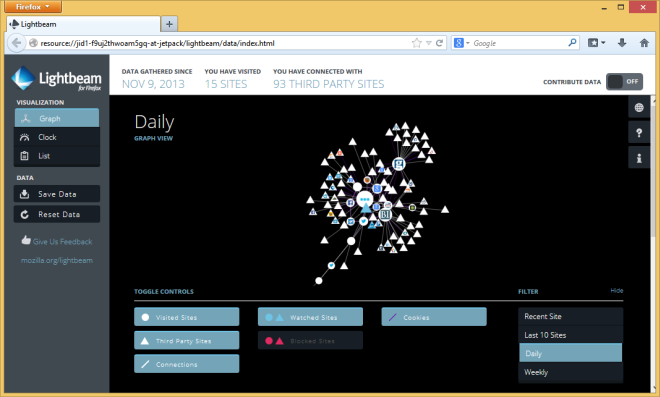
Exploring the Lightbeam for Firefox Graph and Clock Views
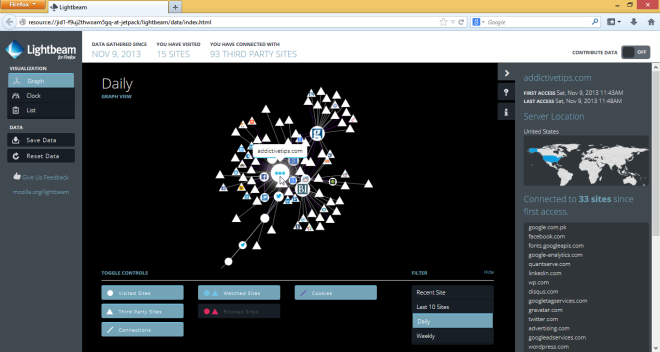
The interface of Lightbeam looks simple and user-friendly. The Graph option creates a zoomable, interactive visualization of your web activities. In the graph, circles represent sites you directly visited, while triangles represent third-party domains that were loaded by those sites in the background. The lines connecting circles and triangles visualize those relationships — showing which third-party domains are associated with which sites you browsed. You can recognize each site via its favicon displayed on its shape, and the more connections a site shares, the bigger its shape gets, making it easy to spot the most active third parties at a glance.
It is worth noting that the graph visualizes network-level connections and known trackers as reported by your browser. It does not by itself prove what data payload was transmitted on any given connection, and a connecting line does not guarantee that a cookie was set on every interaction. Think of it as a relationship map rather than a definitive audit log — a useful starting point for investigation, not a forensic record.
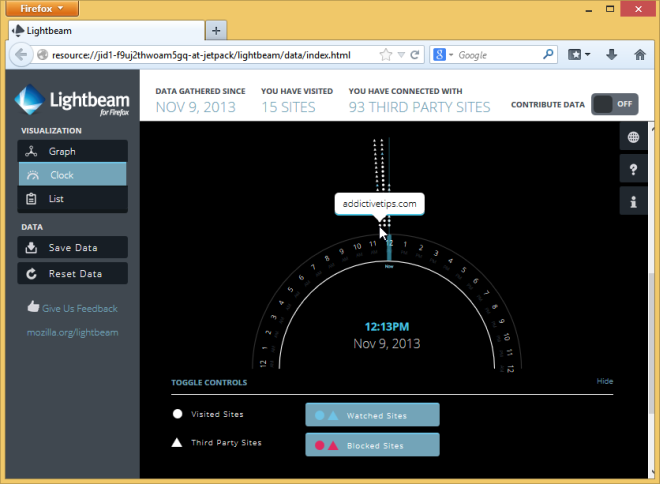
The second main feature of Lightbeam is its Clock view mode. This section monitors and displays your online activity data over the previous 24 hours and plots the results accordingly. It’s more like a timeline that lets you know exactly the time when you visited a particular site, and what kind of information was collected by third-party services during that visit. The Clock view is particularly useful for identifying patterns in how trackers follow your browsing sessions throughout the day.
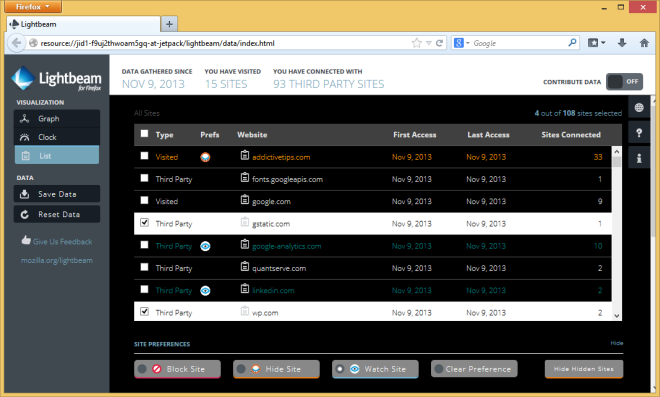
Lastly, there’s the List view that enables you to further examine the aforementioned data in a sort-able list format. For each entry, it shows the site type and name, first and last access times, sites connected, and so on. From the same page, you can batch-select visited and/or third-party sites, and choose to block, hide or watch them. This granular level of control gives users a practical way to manage their privacy without needing any advanced technical knowledge.
You can easily save all available information as a JSON file should you need to further analyze it. In addition, you can contribute your data to Lightbeam servers via the ‘Contribute Data’ toggle in the top right of the screen to help the cause of web transparency.
What Lightbeam Stores, Shares, and Its Limitations
Lightbeam is an education and research tool, and understanding what it does — and does not — do with your data is important before you install it.
Local storage and private browsing: Lightbeam stores the connection data it collects locally on your device. If you browse in a private window, that activity may appear in the Lightbeam visualization in real time, but it is not written to local storage and will be cleared automatically when Lightbeam restarts. Private browsing data is never sent anywhere.
History dependency: Lightbeam works by analyzing your browser activity as you browse. If you have disabled Firefox’s browsing history in your privacy settings, Lightbeam may not be able to collect usable results. For a meaningful test session, make sure history is enabled at least during the time you want to monitor.
The Contribute Data feature is optional: The ‘Contribute Data’ toggle you see in the Lightbeam interface is entirely separate from the tool’s core local functionality. Using Lightbeam to visualize your own connections does not automatically share anything. Only if you explicitly enable Contribute Data will anonymized information be sent to the project’s servers to support broader web transparency research.
Permissions: The extension requests access to your browsing activity in order to do its job. This is a required permission for the core visualization to work. No other access to site data beyond what is needed for tracking visualization is required for standard use.
What Lightbeam is not: Lightbeam does not block trackers. It does not modify requests, strip cookies, or protect you in the way that a content blocker or a VPN would. Its purpose is to make third-party tracking relationships visible so that you can make more informed decisions — it is a transparency and awareness tool first, and should be used alongside, not instead of, dedicated privacy tools like Firefox’s built-in Enhanced Tracking Protection.
Lightbeam for Firefox is an open-source tool, and its source code is available at GitHub, while the add-on itself can be downloaded via the link below.