Secure Your Passwords And Login To Multiple Websites In A Single Click
Modern web browsers — including Chrome, Edge, Safari, and Firefox — all include built-in password managers that are more capable than many people realize. These tools do encrypt your stored credentials, typically sync across your devices through your Google, Microsoft, Apple, or Firefox account, and in most cases allow you to save multiple sets of login details for the same website. For everyday use, they are a genuine improvement over reusing the same password or writing credentials down.
That said, built-in browser managers have real limitations that matter as your needs grow. They are tied to a single vendor’s ecosystem, which makes it harder to move your credentials if you switch browsers or platforms. Modern browser tools have improved considerably — Google Password Manager, for instance, includes Password Checkup, which identifies compromised, weak, and reused passwords, and supports cross-device sync with autofill across Chrome, Android, and iOS. Even so, dedicated managers still hold meaningful advantages: they are vendor-neutral and portable across any browser or platform, offer richer secure sharing options, support family and business vaults, provide emergency access features, offer local-only or self-hosted storage options, allow file attachments, and generally cover a broader range of apps. If you manage a large number of accounts across multiple devices, want to share credentials securely, or prefer a vault that works equally well on Windows, macOS, Android, and iPhone regardless of which browser you use, a dedicated password manager is well worth considering.
What Is a Password Manager and How Does It Work?
A password manager is a secure application that stores all of your login credentials inside an encrypted vault. Instead of remembering dozens of different passwords, you remember one strong master password that unlocks the vault — everything else is handled for you automatically.
Most modern password managers work across all of your devices through a combination of a browser extension, a mobile app, and sometimes a desktop app. When you visit a login page, the extension detects the form and offers to autofill your saved credentials. When you create a new account, the built-in password generator suggests a long, random password so you never have to invent one yourself. Your vault syncs securely across your devices so your passwords are available whether you are on your laptop, phone, or tablet.
Here is a quick summary of the core jobs a password manager handles:
- Generate long, unique, random passwords for every account
- Store login credentials inside an encrypted vault
- Autofill usernames and passwords on websites and in apps
- Reduce password reuse across your accounts
- Sync credentials across all your devices
- Optionally store passkeys, payment card details, and secure notes
Why You Need a Dedicated Password Manager
Storing passwords in your browser might feel convenient, but it leaves your credentials exposed to anyone who has physical or remote access to your computer. A standalone password manager encrypts your login data behind a master password, meaning your credentials are never stored in plain text. Security researchers consistently recommend using a dedicated tool rather than relying on browser-based storage, because the encryption standards and access controls are generally more robust. If you share a computer with others, or if your machine is ever compromised, a proper password manager is your first line of defense.
It is worth being accurate about where browser-based managers have improved and where gaps remain. Google Password Manager now includes Password Checkup, which flags compromised, weak, and reused passwords, supports cross-device sync, and offers autofill across Chrome, Android, and iOS — features that matter and should not be dismissed. Apple’s iCloud Keychain similarly offers breach detection and passkey support across Apple devices. These are genuinely useful tools for many users. Where dedicated managers continue to pull ahead is in vendor-neutral portability (your vault works regardless of which browser or platform you are on), richer secure sharing between individuals or families, business and team vaults with granular permissions, emergency access for trusted contacts, self-hosting and local-only vault options for users with stricter privacy requirements, the ability to attach files to vault entries, and broader autofill coverage inside desktop and mobile apps beyond the browser.
Beyond security, a dedicated tool also gives you far greater flexibility. You can organize logins into groups, launch multiple websites in a single click, and keep your credentials portable across sessions — none of which is possible with a standard browser’s built-in feature.
The best dedicated password managers are built on a zero-knowledge design, which means the provider cannot read your vault contents even if they wanted to. Your data is encrypted and decrypted locally on your device using your master password as the key, and only the encrypted blob is ever sent to the cloud. This is a meaningfully stronger model than relying on browser-based storage alone, where access controls and security architectures vary significantly across vendors.
Because your master password is the single key that protects everything, choosing a strong, memorable one matters enormously. Pick a long passphrase — several unrelated words strung together — that you can recall without writing it anywhere obvious. Beyond the master password, take advantage of any multi-factor authentication (MFA) option the manager offers, whether that is an authenticator app, biometric unlock on your phone, or a hardware security key. MFA means that even if your master password is ever exposed, an attacker still cannot open your vault without that second factor.
Most reputable password managers also include password-health features that work silently in the background. Breach monitoring compares your stored email addresses and passwords against known data-breach databases and alerts you if your credentials appear. Weak-password detection flags any passwords that are short, simple, or commonly used, while reused-password detection highlights cases where you have used the same password across multiple sites — the single biggest risk factor in account takeovers.
One practical decision you will need to make is whether you prefer a cloud-synced vault or a local-only one. Cloud-synced managers keep your vault accessible on every device and update in real time, but your encrypted data lives on the provider’s servers. Local-only managers keep the vault file entirely on your own hardware, which some users prefer for privacy, though syncing across devices requires extra setup. Neither approach is objectively better — it depends on your priorities.
Finally, plan for account recovery before you need it. Many zero-knowledge managers cannot reset or recover a forgotten master password, because doing so would require them to decrypt your vault — which they cannot do by design. Create a strong master password you can genuinely remember, store an emergency recovery code (if the service provides one) somewhere physically secure, and consider setting up a trusted emergency contact if the manager supports it.
Are Password Managers Safe?
The most common objection to password managers is an understandable one: putting all your passwords in one place feels like a single point of failure. It is a fair concern, and it deserves a direct answer.
A reputable password manager is, in practice, significantly safer than the alternatives most people are actually using — password reuse across dozens of sites, credentials saved in an unprotected spreadsheet, sticky notes on a monitor, or entries stored in a standard notes app with no encryption. Password reuse is the single largest driver of account takeovers. When one site suffers a breach and your reused password is exposed, every account sharing that password becomes vulnerable. A password manager eliminates reuse entirely by generating a unique, random password for every account.
That said, no security tool is without risk, and being honest about the real threats matters:
- Phishing and fake autofill prompts: A good password manager will only autofill credentials on the exact domain they were saved for, which provides meaningful phishing protection. However, malicious browser extensions or convincing fake login pages can still catch users off guard.
- Malware on a compromised device: If your device is already infected with keylogging or screen-capture malware, an attacker may be able to capture your master password or vault contents when the vault is unlocked. Keeping your operating system and apps updated is essential.
- A weak or forgotten master password: Your master password is the linchpin. A short or guessable one undermines the entire system. A forgotten one, with no recovery plan in place, can permanently lock you out of your vault.
- Unsafe recovery practices: Storing your recovery code in an insecure location — an unencrypted email draft, a notes app, a photograph on an unprotected phone — creates a backdoor that defeats the purpose of the vault.
- Cloud versus local trade-offs: A cloud-synced vault is convenient and resilient against device loss, but your encrypted data lives on a third-party server. A local or self-hosted vault keeps data entirely under your control but requires you to manage your own backups and sync.
The bottom line is that a well-configured password manager, used with basic security hygiene, is far safer than any realistic alternative for most people. Here is a short checklist to get the most out of it safely:
- Choose a manager that has been independently audited and publishes its results
- Enable multi-factor authentication on the vault itself
- Keep your devices, operating system, and browser extensions updated
- Review breach alerts promptly and change flagged passwords immediately
- Store your emergency recovery code offline in a physically secure location
- Use passkeys wherever they are supported, as they eliminate the password entirely
How to Choose the Right Password Manager
With dozens of options available, picking the right password manager comes down to a handful of practical criteria. Work through the list below before committing to any tool:
- Platform support: Does it work on all your devices? Look for apps on Windows, macOS, Android, and iPhone, plus extensions for your preferred browser.
- Autofill: Can it autofill login forms on websites and inside mobile apps reliably?
- Password generation: Does it generate strong, customizable passwords at the point of account creation?
- Import and export: Can you bring in passwords from your browser or a previous manager, and export them later if you switch?
- Cross-device sync: Does it keep your vault up to date across all your devices automatically?
- Secure sharing: Can you share individual credentials or folders with a family member or colleague without revealing the underlying password?
- Breach monitoring: Does it alert you when your accounts appear in known data breaches?
- MFA and biometric unlock: Does it support two-factor authentication and fingerprint or face unlock to protect the vault itself?
- Passkey support: Does it store and manage passkeys, the emerging passwordless login standard?
- Transparent security practices: Has the service published independent security audits? Is any part of the code open source so the community can verify its claims?
Here is how the mainstream options compare across the criteria that matter most at the time of writing:
Bitwarden
- Free plan: Unlimited passwords, unlimited devices, cross-device sync included at no cost
- Platform support: Windows, macOS, Linux, Android, iOS, all major browsers
- Passkey support: Yes, including storage and autofill of passkeys
- Secure sharing / family plans: Secure sharing available; family plan supports up to six users
- Emergency access: Yes, via trusted contacts on paid plans
- Breach monitoring: Yes, integrated with Have I Been Pwned
- Open source / self-hosting: Fully open source; self-hosting supported on your own server
- Starting price: Free; Premium from $10/year; Family from $40/year
1Password
- Free plan: No free tier; 14-day trial available
- Platform support: Windows, macOS, Linux, Android, iOS, all major browsers
- Passkey support: Yes, with strong integration across platforms
- Secure sharing / family plans: Excellent family and team sharing; family plan covers up to five users
- Emergency access: Yes, via trusted family or team members
- Breach monitoring: Yes, via Watchtower, which monitors breaches, weak passwords, and expiring 2FA
- Open source / self-hosting: Not open source; cloud-only (with a unique Secret Key model for additional protection)
- Starting price: Individual from $2.99/month; Families from $4.99/month
Proton Pass
- Free plan: Unlimited logins and notes on unlimited devices; limited sharing
- Platform support: Windows, macOS, Linux, Android, iOS, all major browsers
- Passkey support: Yes
- Secure sharing / family plans: Secure sharing on paid plans; family plan available
- Emergency access: Not currently available
- Breach monitoring: Yes, included on paid plans
- Open source / self-hosting: Open source; cloud-based with strong privacy focus from the makers of ProtonMail
- Starting price: Free; Pass Plus from $1.99/month; Family plan available
NordPass
- Free plan: Unlimited passwords but limited to one active device at a time
- Platform support: Windows, macOS, Linux, Android, iOS, all major browsers
- Passkey support: Yes
- Secure sharing / family plans: Secure sharing on paid plans; family plan for up to six users
- Emergency access: Yes, on paid plans
- Breach monitoring: Yes, data breach scanner included on paid plans
- Open source / self-hosting: Not open source; cloud-based
- Starting price: Free; Premium from $1.69/month; Family plan available
Dashlane
- Free plan: Limited to one device and up to 25 passwords
- Platform support: Windows, macOS, Android, iOS, all major browsers
- Passkey support: Yes
- Secure sharing / family plans: Secure sharing; family plan for up to ten users
- Emergency access: Yes
- Breach monitoring: Yes, real-time dark web monitoring included on paid plans
- Open source / self-hosting: Not open source; cloud-based
- Starting price: Free (limited); Premium from $4.99/month; Family plan available
Keeper
- Free plan: No free tier for personal use; limited trial available
- Platform support: Windows, macOS, Linux, Android, iOS, all major browsers
- Passkey support: Yes
- Secure sharing / family plans: Strong sharing controls; family plan for up to five users
- Emergency access: Yes
- Breach monitoring: Yes, BreachWatch dark web monitoring available as an add-on
- Open source / self-hosting: Not open source; cloud-based with optional on-premises deployment for enterprise
- Starting price: Personal from $2.92/month; Family plan available
Google Password Manager
- Free plan: Completely free
- Platform support: Chrome on all platforms, Android, iOS (via Chrome app)
- Passkey support: Yes, with strong Google account integration
- Secure sharing / family plans: No secure sharing or family vault features
- Emergency access: Not available
- Breach monitoring: Yes, Password Checkup flags compromised, weak, and reused passwords
- Open source / self-hosting: Neither; tied entirely to the Google ecosystem
- Starting price: Free
Based on this comparison, here are quick picks by use case:
- Best free option: Bitwarden — unlimited passwords and devices on the free tier, open source, and independently audited
- Best for families: 1Password Families or Bitwarden Families — both offer proper shared vaults with granular permissions
- Best for privacy and open source: Bitwarden (self-hosted) or Proton Pass — both are open source and offer strong privacy credentials
- Best for sharing and collaboration: 1Password — Watchtower, polished sharing features, and excellent team controls
- Best built-in / browser-native choice: Google Password Manager for Android and Chrome users, iCloud Keychain for those fully within the Apple ecosystem — free, capable, and zero setup required
If you are a Windows user who wants something lightweight and free, QuickLogin — covered in the next section — can handle basic credential storage. Keep in mind, however, that it is a limited, Windows-only utility rather than a full-featured cross-platform password manager, and it should not be considered representative of what modern dedicated managers offer.
How to Set Up and Switch to a Password Manager
Choosing a password manager is only half the job. Actually migrating to it and getting it running on all your devices is where most people stall. The process is straightforward when you take it one step at a time.
Step 1: Create a strong master passphrase
Before you create your account, decide on your master password. Use a passphrase — four or more unrelated words strung together, such as a phrase only you would construct — rather than a short complex password. It should be long enough that you can remember it without writing it down in an insecure place. This is the one password you must not forget.
Step 2: Export your existing passwords
Most browsers and managers let you export your saved credentials as a CSV file. Here is where to find the export option in common sources:
- Chrome: Go to chrome://password-manager/passwords, click the settings icon, and choose Export passwords
- Edge: Go to edge://wallet/passwords, click the three-dot menu, and select Export passwords
- Safari: Open Settings (or System Preferences on Mac), go to Passwords, and use File > Export All Passwords
- Firefox: Open the Passwords section in Settings and use the three-dot menu to export as CSV
- Existing manager: Find the Export option in your current manager’s settings and save the CSV to a temporary location
Keep this CSV file only as long as you need it. It contains your passwords in plain text and should be deleted securely once the import is complete.
Step 3: Import into your new manager
Every major password manager includes an import tool, usually found in the web vault or desktop app settings. Select the source (Chrome, Bitwarden, LastPass, generic CSV, and so on), upload the file, and the manager will map your credentials automatically. Review the results and check for any entries that may need a URL or username added.
Step 4: Install the browser extension and mobile app
The browser extension is what makes autofill work reliably on websites. Install it from your manager’s official site or from the extension store for your browser — Chrome Web Store, Firefox Add-ons, or the Edge Add-ons store. Then download the mobile app for iOS or Android from the App Store or Google Play. Sign in with your account on each device.
Step 5: Enable autofill on your phone
The mobile autofill service needs to be turned on in your device’s system settings, not just inside the app:
- Android: Go to Settings > Passwords & accounts (or Autofill service, depending on your device) and select your password manager from the list
- iPhone / iPad: Go to Settings > General > AutoFill & Passwords, enable AutoFill Passwords, and select your manager from the list of sources
Once enabled, your manager will offer to fill credentials inside apps and in Safari or Chrome on iOS, and in any app on Android.
Step 6: Run a password-health audit and fix the worst offenders first
Open the password-health or Watchtower section of your new manager. Every reputable tool will flag three categories: compromised passwords (found in known breaches), reused passwords (the same password used on multiple sites), and weak passwords (short or simple ones). Start with any compromised passwords — go to those sites and change them immediately, letting your manager generate a new unique password for each. Work through reused passwords next, as these represent your biggest exposure.
Step 7: Save your recovery code and enable MFA
Before you close your new manager and rely on it fully, do two things. First, find your emergency recovery kit or recovery code in the manager’s settings and print or write it down, then store it somewhere physically secure — not on your computer or in an unencrypted notes app. Second, enable multi-factor authentication on your manager account. Use an authenticator app (such as Authy or Google Authenticator) or, if the manager supports it, a hardware security key such as a YubiKey for the strongest protection. With MFA enabled, your vault is protected even if your master password is ever exposed.
QuickLogin: A Free Password Manager for Windows
QuickLogin is a free tool for Windows that functions as a lightweight password manager, letting you store all your credentials securely and launch multiple websites instantly. To get started, you first create a QuickLogin file and protect it with a master password. Once the file is set up, click Add from the right sidebar and begin entering the websites and their login details. Note that the freeware version limits you to 10 websites per file, which is sufficient for most casual users.
To launch a website, right-click its entry and select Login current from the context menu. You can also log in to multiple websites simultaneously, as shown in the screenshot below.
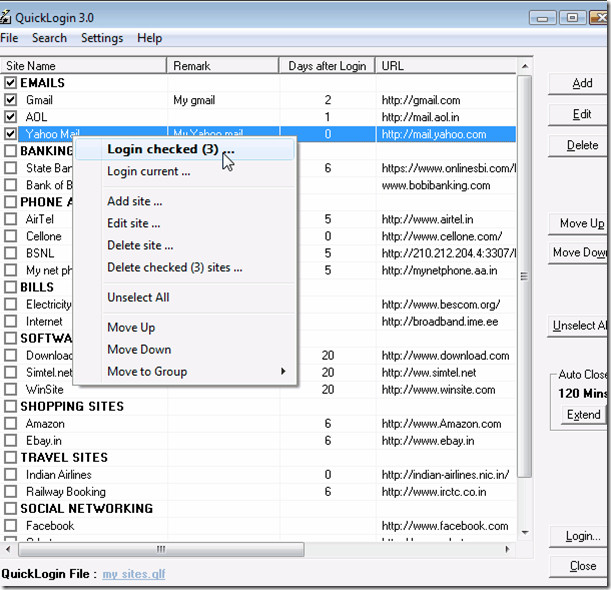
As you can see in the screenshot above, all websites have been arranged into groups. This makes finding and launching the right login much easier, especially when you are managing accounts across many different services. Grouping is a small feature, but it makes a noticeable difference when your list of saved sites starts to grow.
Another convenient way to launch websites is directly from the system tray menu. This means you can access any saved login without even opening the main application window. The screenshot below shows how the system tray menu looks in practice.
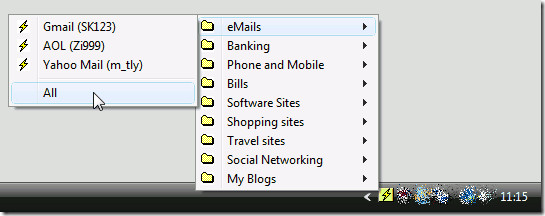
The system tray integration is particularly useful if you switch between accounts throughout the day. Rather than navigating through the full interface, a single right-click on the tray icon gives you instant access to all your saved logins.
With QuickLogin acting as your personal password manager, you can both secure your login details behind strong encryption and launch your favorite websites quickly with a single click. It is a practical solution for anyone who manages multiple accounts and wants to stop relying on insecure browser-based storage. Give it a try and see how much time it saves you. Enjoy!