DualClip Translator: Use Hotkeys To Translate Foreign Language Text
When browsing through different websites, we often stumble upon text in a foreign language. DualClip Translator is a free, open source utility for translation of selected text, pulling results from Google or Microsoft’s translation engines — without requiring you to open a separate browser tab or window.
Sometimes, there is an option on the website itself to change the default language to English, but some small websites do not have this feature available. Almost everyone knows about Google Translator and its usefulness when viewing web pages in another language, however, it requires you to open Google Translate in your browser, copy the URL or text in the window, and then it will be translated.
Instead of doing all that, DualClip Translator lets you translate text without leaving your current application. The translated text is shown either in a system tray balloon, or a pop-up window. You can set a preferred language for text to be translated into, and change hot keys for different functions such as translate, change the original text, copy the translated text, paste translated text to clipboard, screen capture etc.
Getting Started with DualClip Translator
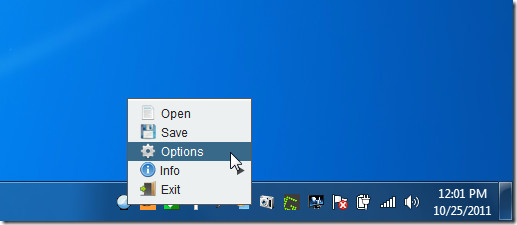
To start, first set the preferences of DualClip by right-clicking its system tray icon and choosing Options.
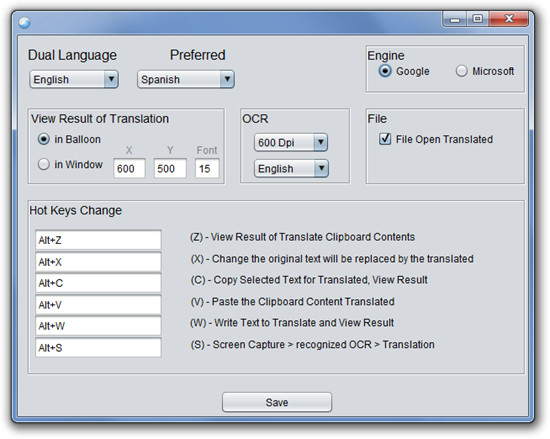
In Options, first set the Preferred and Dual language, and define Google or Microsoft as the translation service. Under View Result of Translation, choose if you want the translation to appear in Balloon or in Window. You can also change the window size, font and OCR’s (Optical Character Recognition) dpi and language. DualClip allows you to set hotkeys for six functions that this application performs.
By default, the hotkeys are Alt+Z (to view result of translated clipboard contents), Alt+X (to translate and replace the original text), Alt+C (to copy selected text and view result), Alt+V (to paste the translated text In clipboard, Alt+W (to write text to translate and view result and Alt+S (for screen capture function). Once all settings are configured, click Save.
You can now use the application entirely with hotkeys. Here is what each default shortcut does — and remember, all of these can be reassigned in Options if the defaults do not suit your workflow:
- Alt+Z — Translates whatever text is currently in your clipboard, displays the result, and copies the translation back to the clipboard.
- Alt+X — Works on text you have selected on screen. DualClip auto-copies that selection, translates it, and pastes the translated version over the original text.
- Alt+C — Copies your selected text, translates it, shows the result in the pop-up window or tray balloon, and sends the translation to the clipboard.
- Alt+V — Translates the current clipboard contents and pastes the translated text directly into the active application.
- Alt+W — Opens a text-entry window where you can type or paste text to translate. Press Enter to translate, or Esc to cancel.
- Alt+S — Starts the screen capture mode so you can select a region for OCR and translation.
Select a foreign language text, and press Alt+C to view its translation.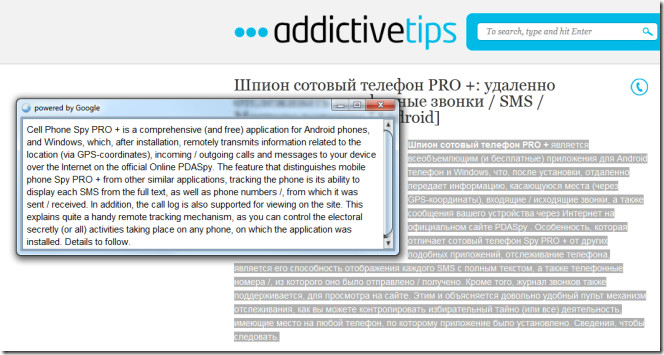
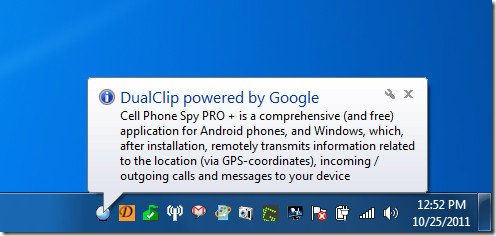
You can also view the translation in a system tray balloon.
Alt+X is designed for text you have selected on screen: DualClip automatically copies that selection, translates it, and pastes the translated version back over the original. If the text you want to translate is only in your clipboard and not selected on screen, use Alt+Z instead to translate the clipboard contents and view or copy the result, or use Alt+V to translate the clipboard contents and paste them directly into your active application.
Using DualClip Translator for Screen Capture and OCR (Alt+S)
The Alt+S shortcut is one of DualClip’s most distinctive features, letting you translate text that appears anywhere on your screen — even inside images or video frames. Press Alt+S and your cursor will enter capture mode. Click and drag to draw a rectangle around the text you want to capture. If you want to cancel the capture at any point, right-click to exit without translating.
By default, DualClip will OCR the selected region, translate the recognized text, and display the result in the pop-up window or tray balloon while also placing it on the clipboard. If you only want to capture and recognize the text without translating it, hold Ctrl or Shift while left-clicking during the capture.
DualClip uses Tesseract for OCR processing. For the best recognition accuracy, keep these practical tips in mind: capture text that sits inside a clear, well-defined frame, and make sure the text is on a solid, non-transparent background. Busy or low-contrast backgrounds will reduce accuracy noticeably.
To save a translated result in a text file, right-click DualClip’s system-tray icon and click Save. DualClip Translator has been available in builds up to v2.6, with support noted for both Windows and Linux, and requires a Java runtime (OpenJDK is a suitable option). Note that this review was conducted on an older build; if you are running a current Windows release, check the project page to confirm compatibility with your specific version before downloading.