How To Recover Wireless Network Keys (WEP/WPA) From Windows 7
Did you ever forget your wireless network password? Whether you need to recover wireless network keys from your own PC or retrieve a saved passphrase you no longer remember, there is a simple solution available. Maybe you also want to recover the keys of the wireless network in the office or at your friend’s apartment — either way, the process is straightforward with the right tool.
WirelessKeyView is a free portable tool for Windows that allows you to instantly recover your lost wireless network keys. It has been developed by Nirsoft, the same guys that brought you OpenFilesView, OutlookAttachView, and Asterisk Logger among many others. Nirsoft has a long-standing reputation for building lightweight, no-install utilities that solve real Windows problems without any bloat or complicated setup.
What a Wireless Network Key Actually Is
Before diving into recovery methods, it helps to know exactly what you are looking for. A wireless network key is simply your Wi-Fi password — the string of characters you type when joining a wireless network for the first time. Depending on where you encounter it, this same credential may be labelled in different ways: Wi-Fi Password, Wireless Key, Network Security Key, WPA2 Password, WPA3 Password, or Pre-Shared Key (PSK). All of these terms refer to the same thing: the passphrase that secures your wireless network.
It is important not to confuse the wireless network key with your router’s admin password. The admin password is what you use to log into the router’s settings page (usually at an address like 192.168.1.1) to change configuration options. The two passwords are completely separate and are often different values, even though both may be printed on the same sticker on the back of your router.
One additional caveat worth knowing upfront: enterprise Wi-Fi networks — those using WPA2-Enterprise, WPA3-Enterprise, or the 802.1X authentication standard common in offices and universities — typically do not use a single shared recoverable password the way home networks do. On those networks, each user authenticates with their own credentials, so the methods below may not apply.
How to Recover a Saved Wi-Fi Password in Windows Without Extra Software
Before reaching for a third-party tool, it is worth knowing that Windows 10 and Windows 11 include two built-in ways to reveal a saved Wi-Fi password. Both methods only work for networks your PC has connected to before, since Windows can only show credentials it has already stored.
Method 1: Using the Network Connections GUI
This approach works entirely through point-and-click settings and requires no typing of commands.
- Press Windows key + R, type ncpa.cpl, and press Enter to open Network Connections.
- Right-click your Wi-Fi adapter and choose Status.
- In the Wi-Fi Status window, click Wireless Properties.
- Select the Security tab.
- Tick the Show characters checkbox to reveal the saved network security key in plain text.
Method 2: Using the Command Prompt
The command-line approach lets you retrieve the password for any saved profile, including networks you are not currently connected to.
- Open Command Prompt or Windows Terminal as an administrator.
- Run netsh wlan show profiles to list every Wi-Fi profile saved on the machine.
- Find the name of the network you want, then run netsh wlan show profile name=”SSID” key=clear, replacing SSID with the exact network name.
- Scroll down to the Security settings section and look for the Key Content field — the value shown there is your Wi-Fi password.
Both methods are completely free and leave no footprint on your system. If either one returns no result or the Key Content field is blank, there are several possible explanations beyond the profile simply not existing: the terminal may not have been opened as administrator, the SSID name may have been entered with a slight difference in spacing or capitalisation, the Wi-Fi profile may be corrupted, or the network may be a WPA2/WPA3-Enterprise connection that does not store a shared PSK at all. Note that netsh wlan show profile name=”SSID” key=clear will only populate the Key Content field for personal or PSK-based networks — enterprise profiles will show the security type but reveal no shared key. If the profile is missing entirely, check whether the SSID appears in the output of netsh wlan show profiles first, then try the alternative methods covered below.
How to Recover Wireless Network Keys Using WirelessKeyView
Getting started with WirelessKeyView is incredibly simple. Just download the tool from the Nirsoft website, extract the zip file, and run the executable — no installation is required. Within seconds, it will list all the networks your computer has previously connected to, along with their saved keys, in a clean and easy-to-read list view. There is no need to dig through Windows settings or use the command prompt.
Windows stores saved Wi-Fi credentials in a protected area of the system, but WirelessKeyView is able to read and display them in plain text. This makes it especially useful when you need to share a Wi-Fi password with someone but cannot remember what it is. The tool supports Windows XP SP1 through Windows 11, covering virtually every modern machine you are likely to encounter. Administrator access is required in all cases — if the list comes back empty, right-click the executable and choose Run as administrator before concluding that no profiles exist.
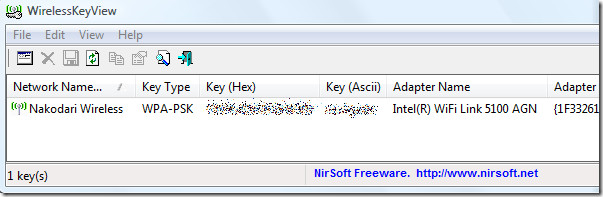
For every network, WirelessKeyView shows the following details: Key Type (WEP, WPA, WPA2, or WPA3-SAE), Key (Hex), Key (ASCII), Adapter Name, and Adapter GUID. This level of detail is helpful not just for recovering a forgotten password, but also for network administrators who need to audit which credentials are stored on a given machine. The hex and ASCII representations of the key are both displayed side by side, so you can use whichever format is required by your router or network device.
It is worth noting that WEP (Wired Equivalent Privacy) is obsolete and considered insecure — you should not be using it on any active network. WPA (Wi-Fi Protected Access) is also outdated and no longer recommended. WPA2 remains widely used and is still considered acceptable for most home and small-business networks. WPA3 is the newest and most secure option and is available on most routers manufactured in the last few years. If WirelessKeyView shows that any of your saved networks are using WEP or WPA, it is a good time to update your router’s security settings. You can learn more about wireless security standards from the Wi-Fi Alliance, the organization responsible for certifying Wi-Fi equipment and maintaining these standards.
Beyond the basic recovery workflow, WirelessKeyView includes several advanced capabilities that are worth knowing about:
- Remote computer recovery. If you have full administrator access and admin shares are enabled on a remote Windows machine on the same network, WirelessKeyView can connect to that machine and retrieve its saved Wi-Fi profiles without you needing to physically sit at it. This is particularly useful for IT admins managing multiple endpoints.
- Exporting and importing keys. You can export the full list of recovered keys to text, HTML, XML, or CSV formats via File > Save All Items, and then import those credentials on another machine. This makes it straightforward to migrate saved Wi-Fi profiles when replacing or rebuilding a PC.
- QR code display. For supported entries, WirelessKeyView can generate and display a QR code for a saved network, which you can then scan with a phone or tablet to join that network instantly — no typing required.
- Command-line and scripted exports. WirelessKeyView supports command-line switches for automated or scripted use. For example, running WirelessKeyView.exe /scomma “output.csv” will silently export all recovered keys to a comma-separated file, which can be incorporated into a backup or deployment script.
A note on the external Windows installation feature specifically: when extracting keys from an offline or external Windows folder, the version of WirelessKeyView running on the host machine must be recent enough to support the profile format used by that external installation. If you are pulling keys from a Windows 11 installation, make sure you are running a current release of WirelessKeyView rather than an older copy that may predate support for newer profile structures.
There are a few important practical points to keep in mind before you use WirelessKeyView. First, the tool only reveals keys that are already saved on the Windows installation you are running it from — if the profile was deleted or never stored on that machine, the tool will return nothing for that network. Second, NirSoft notes that administrator access is required to read the protected credential store, so right-click the executable and choose Run as administrator if the list comes back empty. Third, some antivirus programs may flag password-recovery utilities as a false positive threat. This is a known issue with tools of this type and is not a sign that the software is malicious, but you should always download WirelessKeyView exclusively from the official NirSoft website to make sure you are getting the genuine file.
Here is a quick summary of what WirelessKeyView can and cannot do:
- Displays all Wi-Fi profiles saved on the current Windows installation in plain text
- Shows both hex and ASCII versions of each key
- Lets you copy any key to the clipboard with a single click
- Supports exporting the full list in text, HTML, XML, and CSV formats
- Identifies WPA3-SAE entries on current releases alongside older WEP, WPA, and WPA2 profiles
- Returns no results for networks whose profiles have been deleted or were never saved on that machine
- Cannot recover a password that was set directly on the router if no Windows device ever saved it
Recover Wireless Network Keys from an External Windows Installation
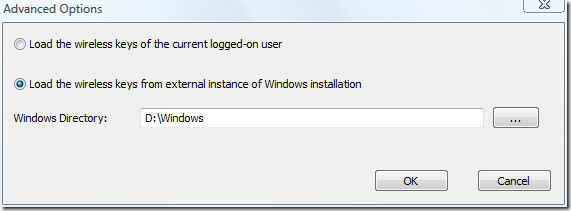
Another great feature of WirelessKeyView is that you can recover wireless network keys from an external Windows installation as well. This is particularly useful if your primary Windows installation has become unbootable or if you are working from a recovery environment. To use this feature, go to File > Advanced Options and select the external Windows installation from which you want to retrieve the saved wireless keys.
This advanced option makes WirelessKeyView a valuable tool for IT professionals and system administrators. For example, if a user’s machine fails to boot and they need to reconnect to the corporate Wi-Fi on a replacement device, you can boot from a live environment, point WirelessKeyView at the old Windows folder, and extract the necessary credentials in moments. No data recovery software or complex forensic tools are needed. Current versions of WirelessKeyView also support newer Windows builds and can handle the more recent Wi-Fi profile formats introduced in Windows 10 and Windows 11, so the tool remains reliable across the full range of modern installations you are likely to encounter.
WirelessKeyView also allows you to export the list of recovered keys to a text file or HTML report, which can be handy for documentation purposes. Simply go to File > Save All Items to export the full list. This is a convenient way to keep a secure backup of your Wi-Fi credentials, especially in environments where multiple networks are in use.
Overall, WirelessKeyView is one of the most reliable and user-friendly ways to recover wireless network keys on a Windows PC. It is completely free, requires no installation, and delivers results instantly. Whether you are a home user who forgot a password or an IT professional managing multiple machines, this tool is well worth keeping in your utility toolkit. Give it a try the next time you find yourself locked out of a saved network.
If Windows or WirelessKeyView Shows Nothing
If you have run through the built-in Windows methods and WirelessKeyView and still cannot see the key you need, do not give up yet. There are several distinct reasons recovery can fail, and the fix depends on which one applies to your situation.
The tool was not run as administrator. This is the most common cause of an empty result. Both the command-line method and WirelessKeyView require elevated privileges to read the protected credential store. Close the application, right-click it, choose Run as administrator, and try again before concluding anything else is wrong.
Antivirus quarantined the utility. Some security software will silently quarantine WirelessKeyView before it can run, producing no output rather than an error. Check your antivirus quarantine log and restore the file if needed, then re-run it with administrator rights. Always ensure you downloaded the tool directly from the official NirSoft website.
The SSID name was entered incorrectly. The command netsh wlan show profile name=”SSID” key=clear requires the network name to match exactly — including capitalisation, spaces, and any special characters. Run netsh wlan show profiles first, copy the name exactly as it appears in the output, and paste it into the second command.
The Wi-Fi profile was deleted or the device never saved the network. If the SSID does not appear at all in the output of netsh wlan show profiles, the profile is simply not present on this machine. This can happen if the profile was manually removed, the machine was recently rebuilt, or the device connected via a guest session that did not persist credentials.
The network is enterprise or 802.1X-based. If the profile shows in the list but no Key Content appears, the network may be using WPA2-Enterprise or WPA3-Enterprise authentication. These networks issue per-user credentials rather than a single shared key, so there is nothing for Windows or WirelessKeyView to reveal. Contact your network administrator for access credentials.
The router password was changed after the device last connected. If a device saved a password that has since been updated on the router, the stored key will be the old one. The device may even show as connected (if it has not tried to re-authenticate yet) while the recovered password no longer works on other devices.
The WLAN profile is corrupted. Occasionally a saved profile exists in the list but is damaged and cannot be read correctly. Try deleting the profile with netsh wlan delete profile name=”SSID” and reconnecting to the network if you have another way to obtain the password first.
Use this decision tree to work through the problem systematically:
- Run netsh wlan show profiles — does the SSID appear in the list?
- If yes, run the netsh wlan show profile name=”SSID” key=clear command in an elevated terminal and check for Key Content.
- If Key Content is blank, confirm whether this is a personal or enterprise network, and verify the terminal has administrator rights.
- If the SSID does not appear at all, check another device that is already connected to the network — it may have the password saved.
- If no device has the password saved, your next step is to log into the router admin page or check the label on the router itself.
- If neither of those options is available, a factory reset of the router is the last resort.
If the Password Is Not Saved on Your PC, Check the Router
If none of the Windows methods above return a result, the password was most likely never saved on the machine you are using. In that case, your next best options involve the router itself.
Check the router sticker. Most routers have a label printed on the back or bottom of the unit. Look for a field with one of these common labels: Wi-Fi Password, Wireless Key, WPA2 Password, WPA3 Password, Pre-Shared Key, or Network Security Key. The value printed there is the default wireless password the router shipped with. Note that if someone changed the password after initial setup, the printed label will no longer match the current one.
Sign into the router admin page. From any device that is already connected to the network — including a phone or tablet connected over Wi-Fi — open a browser and navigate to the router’s local admin address. Common addresses are 192.168.0.1 and 192.168.1.1, though some routers use a different default. Log in with the router’s admin credentials (often printed on the same label as the Wi-Fi password), then navigate to the Wireless or Wi-Fi Security section. The current passphrase will be displayed there and can be viewed or changed.
Last resort: factory reset. If you cannot access the admin page and the sticker password does not work, a full factory reset will restore the router to its default settings, including the original printed Wi-Fi password. Be aware that a reset disconnects every device on the network and erases any custom configuration, so treat it as a last resort rather than a first step.

Hey idiot who posted this, the creator of the software clearly says in his faq that this currently does not support windows 7.
when i try this wirelesskeyview.exe software in Windows 7 os it does not shown why can you explain me how to solve it
my email id is
jeevan452@hotmail.com